Category Archives: Internet

What is “The Internet of Things”? A 5-min video explains it…

Recently I had someone ask me what this whole “Internet of Things” idea was all about… and I explained that it had to do with all of the sensors, devices, vehicles, etc. that have become connected to IP networks… and while I perhaps answered the question then, just the other day I stumbled across this video in a ReadWriteWeb article that does an outstanding job at painting the larger picture:

Kudos to the folks at IBM who created the video. Nice job.


If you found this post interesting or useful, please consider either subscribing to the RSS feed or following me on Twitter or identi.ca.


R.I.P. GeoCities…

yahoogeocities.jpgAs has been widely reported, Yahoo! is shutting down and deleting all the content from its GeoCities service today. This isn’t a surprise, as Yahoo! has been laying the groundwork for the shutdown for some time. And in truth, I’ll barely mourn the passing… I haven’t intentionally been to a GeoCities-hosted site in years.

But…

…”back in the day”, as folks are so fond of saying now, GeoCities certainly was a place where many people got their start with free websites. For those of us online in the 1990’s… long before all the zillion sites today where you can go and create your own free site… there was GeoCities.

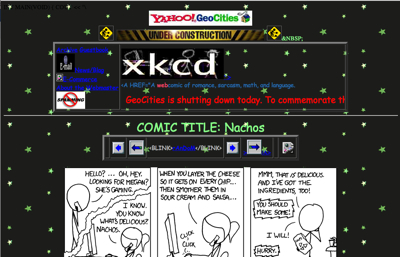
I had websites running on other servers and never set up my own site on GeoCities, but I certainly knew folks who did and undoubtedly spent time on some sites there. It’s amazing on one level that the Yahoo! acquisition was ten years ago… but in recent years the service had definitely been eclipsed and for many of us was more almost a caricature than anything else… (see today’s XKCD layout to get a sense of what the site had become like).

Still, it’s worth noting the passing, because back in the 1990’s, GeoCities certainly did help many people get online. Some articles I noticed today:

And, as I mentioned earlier, the folks at the XKCD comic changed their layout in tribute:

xkcd-geocities.jpg

(P.S. A colleague has pointed out that if you view the source of the XKCD page, it’s even funnier…)


If you found this post interesting or useful, please consider either subscribing to the RSS feed or following me on Twitter or identi.ca.


The “World Wide Web” is 20 years old today…

www20.jpg
It’s hard to believe that the “World Wide Web” is 20 years old today. As written on the “WWW@20” site:

Twenty years ago this month, something happened at CERN that would change the world forever: Tim Berners-Lee handed a document to his supervisor Mike Sendall entitled “Information Management : a Proposal”. “Vague, but exciting” is how Mike described it, and he gave Tim the nod to take his proposal forward. The following year, the World Wide Web was born.

They are having a celebration today over there where Tim Berners-Lee will speak.

When I tug on my ever-greying-beard a bit, I can think back to the some of the “Intro to the Internet” courses I taught in the Boston corporate market (primarily) back in the very early 1990’s. The courseware I wrote had a section at the end that talked about this new thing, called the “World-Wide Web” that you used by telnetting to info.cern.ch and navigating through a “line-mode browser” by typing the number of the link you wanted to follow. This was, of course, the era of “gopher”, “archie”, “veronica”, etc. so this new “www” thing was an interesting addition.

And then, of course, came Mosaic in 1993 and everything changed… (including my courseware! 😉 )

Happy Birthday, World Wide Web! And thanks, Tim Berners-Lee, for writing that first proposal…

Some other coverage:


If you found this post interesting or useful, please consider either subscribing to the RSS feed or following me on Twitter or identi.ca.


Technorati Tags:
, , , , ,

The new “.tel” domain and what it means for communicators…

fir_100x100.gifIf you listened to my report into today’s For Immediate Release podcast #403, you would have heard me speak about a new Internet domain, “.tel”, and a bit about what it means for communicators. Over on my DisruptiveTelephony.com blog, I wrote a lengthy review of the .tel domain that probably goes into way more detail about any of this than many of you care. Still, the post is over there for those interested – and I would encourage you to read the comments as well because someone from Telnic, the company behind the .tel domain got involved as well as someone from a domain name registrar also providing a lengthy reply.

To provide a quick summary, the “.tel” domain is a new top-level domain (TLD) that is designed to be very different from other current TLDs. Rather than be used to point to websites, it is designed to point to contact information. As that contact information is actually stored in the DNS system, it is potentially available much more quickly than through a traditional web-based directory. A key point is also that OWNERS of a .tel domain are the ones responsible for updating the contact info. You can do that on your own local site… so it has the potential to be a massively distributed directory. You can see an example of how this can look at danyork.vip.tel (my page in their beta program).

Now I have a few problems with the idea, which I’ve described in my post but for communicators of the PR/marketing form there are a couple of points to consider:

1. Brand protection in a new TLD – The most obvious concern is that this is a new top-level-domain. Will your brand (or that of your clients) be protected in this new TLD? Will you be able to get yourcompanyname.tel?

One question is – do you care if you you get this domain? (See my point #2 below.) If you don’t, you can stop reading now and go read something else more interesting. If you do care, you should consider that the .tel launch is now in the first of three launch phases:

  • Sunrise – Started yesterday (Dec 3rd). Owners of registered trademarks may apply for .tel domains (at a high cost).
  • Landrush – Starts February 3rd. Anyone can register for any available domain – at a premium cost.
  • General Availability – Starts March 24th. Anyone can register for any available domain at a “typical” cost.

More information about each phase can be found on Telnic’s Launch Information page. So if you are a communicator associated with a trademark-protected brand, you may want to consider whether you want to go in on the Sunrise period and apply for your domain. Or you may want to wait it out. (Or, as was recently voiced to me, you may just view all of these new TLDs as yet-another-attempt to extract money out of you.)

2. Should you care? Will it succeed? – This is honestly a tough one to answer. Global directories have been tried many times before and haven’t really succeeded. I have questions about whether this .tel effort will succeed. I think the potential is intriguing… but I do have to wonder if the technical issues can be overcome.

The question really comes down to this – if it does succeed, or at least do well enough to be useful, do you want your company/brand to be visible at brandname.tel? Or do you see this as yet another attempt to build a directory that probably won’t work and you’ll just wait and see? Ultimately, each of you have to make that choice.

Beyond my post and the excellent comments left to it from someone at Telnic and a domain name registrar, I’d also recommend listening to the Squawk Box episode where we interviewed Telnic’s Justin Hayward (.tel part starts around 17:50).

I think we’d all like to see some kind of better way to find people online… the question is really just whether this is it. (What do you think?)


If you enjoyed this post, please consider either subscribing to the RSS feed or following me on Twitter or identi.ca.


Technorati Tags:
, , , , , ,

Today’s Squawk Box will discuss “Is Google Making Us Stupid?”

squawkbox.jpgOn today’s Squawk Box conference call/podcast at 11am US Eastern, we’ll talk about Nick Carr’s essay in the Atlantic Monthly called “Is Google Making Us Stupid?

Are his concerns valid? Or overblown?

Some of the other links I provided for background:

Knowing the Squawk Box “regulars”, it should be a fun discussion.

If we have time, we might talk about continued information coming out of Apple’s WWDC event and/or the Microsoft TechEd event happening this week. For instance, what do people think about the MobileMe service that I discussed in my blog post.

You are welcome to join us at 11am US Eastern via the Free Conference Calls application for Facebook. The show will also be available for download later in the day on Alec Saunder’s weblog.

Technorati Tags:
, , , , , , , , ,

The Economist’s “MUST READ” Special Report on the “new nomadism” and how our world is changing…

It’s not very often at all that I say that there is something out that I think that people really “must read“. In fact, the last thing I can really thing of that I recommended this strongly was The Cluetrain Manifesto, but that was back in 2000!

economistlogo.jpgSo I find myself a bit surprised to be making that recommendation for a piece in that most mainstream of all business publications, The Economist…. but in my opinion it really is a series of articles that people should read, contemplate, and talk about.

The Special Report, titled “The New Nomadism“, looks at the changes happening in our society as we arrive at this fascinating intersection where we have incredible amounts of network bandwidth available wherever we are – and smaller more powerful devices that can take advantage of that bandwidth. When we can work wherever we want, whenever we want, what does that mean for our society? for our work environment? for our work/life balance? for our communities?

The piece has 7 main articles, several of which go on for several screens:

(FYI, the Economist has made this report available for purchase if you would like it in print form.)

There is also an introductory piece, “Our Nomadic Future“, which is also worth a read.

All together the pieces ask some of the excellent questions that I think we need to be thinking about. I intend to write some further thoughts in the days and weeks ahead. We also discussed this whole piece at some length on the April 16th Squawk Box podcast and it was something I covered in my report into yesterday’s For Immediate Release podcast.

Here’s a taste of the first article in the series:

Urban nomads have started appearing only in the past few years. Like their antecedents in the desert, they are defined not by what they carry but by what they leave behind, knowing that the environment will provide it. Thus, Bedouins do not carry their own water, because they know where the oases are. Modern nomads carry almost no paper because they access their documents on their laptop computers, mobile phones or online. Increasingly, they don’t even bring laptops. Many engineers at Google, the leading internet company and a magnet for nomads, travel with only a BlackBerry, iPhone or other “smart phone”. If ever the need arises for a large keyboard and some earnest typing, they sit down in front of the nearest available computer anywhere in the world, open its web browser and access all their documents online.

Another big misunderstanding of previous decades was to confuse nomadism with migration or travel. As the costs of (stationary) telecommunications plummeted, it became fascinating to contemplate “the death of distance” (the title of a book written by Frances Cairncross, then on the staff of The Economist). And since the early mobile phones were aimed largely at business executives, it was assumed that nomadism was about corporate travel in particular. And indeed many nomads are frequent flyers, for example, which is why airlines such as JetBlue, American Airlines and Continental Airlines are now introducing in-flight Wi-Fi. But although nomadism and travel can coincide, they need not.

Humans have always migrated and travelled, without necessarily living nomadic lives. The nomadism now emerging is different from, and involves much more than, merely making journeys. A modern nomad is as likely to be a teenager in Oslo, Tokyo or suburban America as a jet-setting chief executive. He or she may never have left his or her city, stepped into an aeroplane or changed address. Indeed, how far he moves is completely irrelevant. Even if an urban nomad confines himself to a small perimeter, he nonetheless has a new and surprisingly different relationship to time, to place and to other people. “Permanent connectivity, not motion, is the critical thing,” says Manuel Castells, a sociologist at the Annenberg School for Communication, a part of the University of Southern California, Los Angeles.

This is why a new breed of observers is now joining the ever-present futurists and gadget geeks in studying the consequences of this technology. Sociologists in particular are trying to figure out how mobile communications are changing interactions between people. Nomadism, most believe, tends to bring people who are already close, such as family members, even closer. But it may do so at the expense of their attentiveness towards strangers encountered physically (rather than virtually) in daily life. That has implications for society at large.

Anthropologists and psychologists are investigating how mobile and virtual interaction spices up or challenges physical and offline chemistry, and whether it makes young people in particular more autonomous or more dependent. Architects, property developers and urban planners are changing their thinking about buildings and cities to accommodate the new habits of the nomads that dwell in them. Activists are trying to piggyback on the ubiquity of nomadic tools to improve the world, even as they worry about the same tools in the hands of the malicious. Linguists are chronicling how nomadic communication changes language itself, and thus thought.
Beyond technology

This special report, in presupposing that a wireless world will soon be upon us, will explore these ramifications of mobile technology, rather than the technologies themselves or their business models. But it is worth making clear that technology underlies all of the changes in today’s nomadic societies, so that its march will accelerate them. Wireless data connections, in particular, seem to be getting better all the time. Cellular networks will become faster and more reliable. Short-range Wi-Fi hotspots are popping up in ever more places. And a new generation of wireless technologies is already poised to take over. Regulators have grasped that the airwaves are now among society’s most important assets. America, for instance, has just auctioned off a chunk of spectrum with new rules that require the owner to allow any kind of device and software to run on the resulting network.

Cumulatively, all of these changes amount to a historic merger, at long last, of two technologies that have already proved revolutionary in their own right. The mobile phone has changed the world by becoming ubiquitous in rich and poor countries alike. The internet has mostly touched rich countries, and rich people in poor countries, but has already changed the way people shop, bank, listen to music, read news and socialise. Now the mobile phone is on course to replace the PC as the primary device for getting online. According to the International Telecommunication Union, 3.3 billion people, more than half the world’s population, now subscribe to a mobile-phone service (see chart 1), so the internet at last looks set to change the whole world.

<snip>

The most wonderful thing about mobile technology today is that consumers can increasingly forget about how it works and simply take advantage of it. As Ms Canlas sips her Americano and dives into her e-mail in-box at the Nomad Café, she gives no thought to the specifications and standards that make her connection possible. It is the human connections that now take over.

It is truly a fascinating time that we live in right now, and kudos to the Economist for a strong piece that looks at the larger societal implications of all these changes.

What do you think of all these changes going on?

Technorati Tags:
, , , , ,

Front Porch Forum uses the Internet to connect neighbors

How well do you know your neighbors? How often do you see them? Do you know what’s going on in your neighborhood?

The reality today is that our lives seem to be getting increasingly busier and we very often don’t know our neighbors all that well. Even when we do know our neighbors, we may not see them all that often as our schedules may not overlap. Plus, there are often times of the year when we stay indoors as much as we can (winter in the north, summer in the south) and may see our neighbors only in passing. (Unless, of course, you have a dog, in which case you may see your neighbors a great deal if you walk said dog.)

frontporchforum.jpgHere in Burlington, Vermont, we’ve had an ongoing experiment for the past couple of years in using the global Internet to connect people in their local neighborhood. It’s a service called Front Porch Forum (FPF) that started here in Burlington, has expanded to cover the entire county here in Vermont and is now looking to expand into other parts of the country/world.

One of the interesting aspects is that FPF uses that very decidedly unsexy and un-Web2.0 medium of…

email!

Yes, indeed, the killer app for connecting people in their local neighborhood turns out to be… email mailing lists that are restricted, moderated and digested. You have to live in the neighborhood to join. All messages to the mailing list are moderated. And only one message is sent out every day or so (depending upon volume) containing all the other messages. Think of it as almost a community “newsletter” sent to all members.

I have to say that… it works! You know (or come to know) the people in your community There’s no spam. It doesn’t flood your inbox. There’s no special website you have to go to… you just get the message in your inbox wherever you read your email.

Simple. Easy.

And that is perhaps the key. These days it’s extremely easy to get set up with an email account, and that’s all you need. You can read it whenever you can… so you don’t have to be right there.

Here in Burlington where, according to the Front Porch Forum folks, some 30% of all households are subscribers to their neighborhood forum, it’s been an incredibly useful service. I’ve learned of upcoming events (and posted some). Volunteers have been found for local events. Community associations use it to put out info about their activities. The city of Burlington has taken to sending out notices. Local politicians have posted notices. We’ve had some debates/arguments about certain aspects of our neighborhood (like “should we put a lock on the gate to the beach area?”) Advocates for various causes have posted notes about their views. All sorts of notices, requests, questions, debates… (you can read some testimonials online).

Having been active in our local neighborhood (and on the community association board for a year), I’ve certainly seen the value. People will say “Oh, yeah, I saw that on the forum.” I’ve had neighbors, some of whom I didn’t know, contact me specifically because of notes I’ve posted. Sometimes by email, sometimes by phone and also in person. It has connected our local community together more – and it’s been an interesting experiment to watch.

Now is there any real difference from FPF and just a plain, old, mailing list for a neighborhood using something like Google Groups? On one level, no, not really. It’s just a mailing list after all. The difference really is that with your own mailing list, someone has to administer it. Someone has to deal with spam, either by approving memberships or moderating messages. And the list has to be publicized. The FPF crew takes on the sysadmin issues and moderation tasks. They also make it easy for people to find your local community mailing list because all you need to do is enter your street address.

To get a sense of the project, here’s a video that was recently produced about Front Porch Forum:

Front Porch Forum is also up for a Case Foundation award along with some other great projects and is looking for votes. 🙂

Sadly, when we move to Keene, NH, in a few months I’ll have to leave the FPF behind (at least until they expand into that area). I’ll leave, though, having seen an example of a really old electronic media (email) playing a really neat role in connecting neighbors to neighbors.

Do you have anything similar in your neighborhood? (BTW, you can sign up at Front Porch Forum even if you’re not in Vermont and the FPF folks will contact you if/when they expand into your area.)

Technorati Tags:
, , , ,

TechCrunch: Is OpenID being exploited for PR purposes by the “Big Internet Companies”?

BBA831C6-CAD7-498F-9164-AC5BA8FEADD7.jpgAre the Big Internet Companies (AOL, Google, Yahoo, Microsoft) really committed to OpenID or are they merely exploiting it for PR purposes? That’s the question Mike Arrington asks today over on TechCrunch.

When I last wrote about OpenID back in January, that was pretty much my same question in: “Yahoo supports OpenID… Yaawwwnnn… when can I *login* to Yahoo! services with OpenID?“. As I recounted in that post, I have no problem with getting an OpenID identity. In fact, the problem if anything is that I have too many options for OpenID identities! I can use my own site, my LiveJournal account, my Yahoo account, my AOL/AIM account, etc.

But where can I use my OpenID?

That remains the key question. I want to consolidate my various accounts behind one (or a few) OpenID accounts. I want to be able to login to my Google account with the same OpenID that I use to login to my Yahoo account, my AOL/AIM account, my LinkedIn page, other websites (and heck, why not Facebook, too?)

This is Arrington’s point, really. The “Big Internet Companies” are issuing news releases about their support for OpenID, but are only going halfway. So his point is… is this really just good PR for these companies? That they can use it to look good, but not actually help move OpenID along.

The challenge, of course, is that the “Big Internet Companies” would all like to be that “one account” that I use. They would like to be your “home” on the Internet. So on one level there is a severe DISincentive for them to start accepting OpenIDs for login. If they start accepting OpenID logins, users might potentially use an OpenID account of one of the other Big Internet Companies that have not yet opened up. So if Google opens up first and lets logins via OpenID, users might all use Yahoo accounts as their OpenID. If Yahoo opens up first, users might use a Google account…. and so on.

It’s almost like there needs to be an “OpenID Big Bang Day” when all the big players start accepting OpenID logins. At the agreed-upon time, all the Big Internet Companies start letting people login with an OpenID URL. No one is disadvantaged. Users can just start using whichever account they want. (In fact, maybe the Big Internet Companies might then start offering reasons why they are the better OpenID provider?)

In the meantime, I expect we’ll probably continue in the current state…. many Open ID providers… not as many places to use them. (And yes, I do realize there are an increasing number of smaller sites that are accepting OpenID.)

More coverage today:

Technorati Tags:
,

“w00t!” is now M-W’s Word of the Year? Sigh…

200712130828Okay, maybe I’m just a linguistic pedant, but I just don’t find myself sharing Julia Roy’s joy at the fact that Merriam-Webster has annointed “w00t” (with the zeroes) their “Word of the Year” for 2007! But then again, I didn’t really like “ginormous” being added to the M-W dictionary, either. I know, I know… “languages evolve”… I should just deal with it. Sigh.

To be fair, M-W is not adding “w00t” to their “official” dictionary – at least not yet – and this “Word of the Year” was “based on votes of visitors to our Web site“, which of course will skew any poll that you run. (Although it is in their online “Open Dictionary”.) I did enjoy some of the runner-ups on Merriam-Webster’s list. Somewhat predictable that “facebook” would be on there, but fun to see “conundrum” and “quixotic”.

I think, though, the M-W folks are showing their age when they talk about “l33t” being “an esoteric computer hacker language”. They obviously have not spent any time with teenagers who are madly texting each other. (Although I suppose those who wish to get pedantic about Leet might say that texting and true “leetspeak” are different, but I’d argue there’s a good bit of crossover.) It does, however, warm this linguist’s heart to see someone actually using “esoteric”. Nice word.

Ah, the joy of language! w00t!

Technorati Tags: , , ,

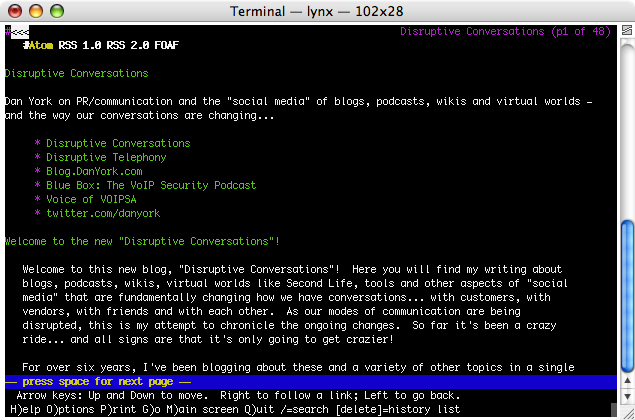
Ahhh… “lynx”… have you ever wondered what your web site looks like in text-only mode?

200710092106When I was complaining in a groupchat today about issues I was having with both Safari and Firefox on my MacBookPro, someone wisecracked that I should get “lynx” if I wanted performance. Having fond memories of lynx – but quite frankly having forgotten completely about it – I immediately I dived to the command line and typed “lynx”, but of course, it wasn’t installed. However, Apple provides lynx as a free download. If you’ve never seen lynx, it’s perhaps worth a look to see what “the Web” sort of looked like around 1993 before Mosaic came out. (Actually, it looked like the original “www” browser at info.cern.ch, but that’s another matter.)

On a serious side, lynx is useful if you want to see what your web pages look like to text-based applications such as those used by the visually-impaired/blind. It’s also fast because of course you get rid of all those pesky graphics, widgets, flash objects, etc. 🙂

Technorati Tags: , , ,