Category Archives: Social Networking

Facebook, MySpace, Twitter and the Return of the Walled Gardens of E-Mail

"Email? I only use that when I have to contact old people!"
      – frequent quote these days from teenagers

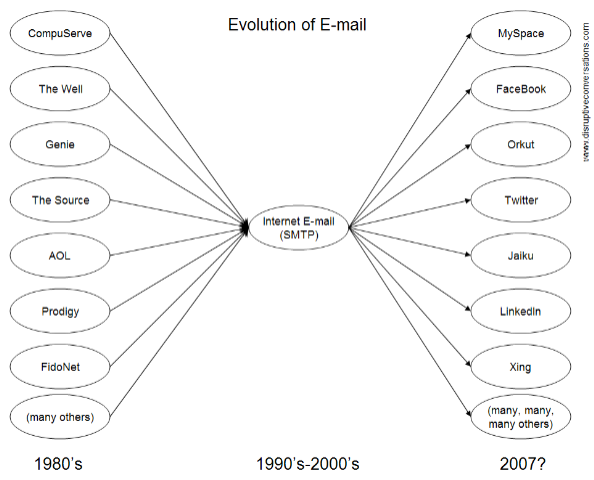
When I started using "the Net" back in mid-1980s, the world of "e-mail" was an incredibly fractured place.  There were the big services of CompuServe, GEnie, The Source, The Well… there were the thousands of small BBS’s… there were "corporate services" like MCI Mail and IBM PROFS… and there were all sorts of others services in the middle (my particular focus in those days was EcoNet, given my involvement then in environmental activism).  They all shared one thing in common:

They were all walled gardens.

Users on the system could only e-mail other users on the same system.  CompuServe users with their (then) numeric accounts could only talk to other CS users.  GEnie users to GEnie users, MCI Mail to MCI Mail… and so on.

But a funny thing happened along the garden path… the walls started to slowly break down.  UUCP started interconnecting UNIX systems.  FidoNet started linking together BBS systems.  X.400 came out and had corporate interest.  And then along came SMTP, which ultimately became the "one email protocol to rule them all" (paralleling the emergence of TCP/IP and the "Internet" as the dominant network in the midst of all the network walled gardens). 

While the fight against the interconnection continued for quite a long time, especially with some of the largest services continuing to try to go it alone, eventually all the services succumbed to the inevitable and provided SMTP gateways that allowed their members to send messages to everyone else. 

All was good – and everyone could send messages to everyone else.

However… a curious thing seems to be happening more and more on this thing we call the Internet.  Increasingly, our messages are NOT moving over what is traditionally known as "email" but instead are migrating to other services.

You could argue that this started some time ago with the walled gardens of instant messaging.  Users of AIM, Yahoo!Messenger, MSN/WLM, Jabber, Skype, IRC, etc. all can have really nice conversations with each other… but no one else.   As IM has continued to grow in usage and replace "traditional" email (which we could argue about why but I personally think it has a lot to do with "presence", but let’s save that for another post another day), we’ve moved to a different messaging paradigm where we write shorter, quicker messages.  And we’ve also become quite comfortable with our IM walled gardens.  It’s routine for people to run several different IM clients (or use something like GAIM that works with multiple services).  Looking down at my task bar, I count 4 IM clients, and I know there are 3 more on my laptop that I could be running.  Now, the walls of IM are slowly breaking down… there’s "federation" now between MSN/WLM and Yahoo.  GoogleTalk can work with Jabber.  Other interconnection services are appearing.

But looking beyond IM, so many conversations now are moving to "social networking services".  The quote I started this article with did not come from any particular place, but it’s the kind of thing that I’ve seen repeated again and again in any interview with teenagers (or even those in their 20s).  The service we know as "email" is today just a "communication mode of last resort" or "least common denominator" to communicate with those too old or clueless. All meaningful communication occurs within the worlds of MySpace, Facebook or any one of a zillion other websites that seem to be popping up on a daily basis. 

And all those sites are chasing each other.  Facebook started out as something of a "college/university version of MySpace"… now it’s added "professional" settings like LinkedIn.  LinkedIn has gone the other way in adding "college" features to attract the college/university crowd.   Orkut started out as more of a dating site and then added other fields and settings. MySpace continues adding new features.  Not a day goes by when there isn’t some notice about a new service that has been launched.

Even Twitter, which I personally use more as a micro-blogging platform, is used as a messaging platform by many.  And the "status" format of Twitter can be found in Facebook as well as newer services like Jaiku.

What do they all have in common?  Simple:

They are all walled gardens.

Each one is a messaging world unto itself.  Facebook users can only see messages from other Facebook users – and only generally when logged into the site.  Ditto LinkedIn…. Xing… MySpace… and others.  Twitter allows the public viewing of messages, but you can also change it to give only updates to friends.  (To "reply" in Twitter, of course, one would need to be a member… and also be "followed" by the person you are replying to.)  Sites like YouTube and Frappr blur the lines by providing messaging as well.

The result, of course, is that like running multiple IM clients, we all have multiple social networking accounts.

How many do you have?

For me, I can remember at least:  LinkedIn, Xing, Facebook, MySpace, Orkut, Twitter, ecademy…  There’s probably a dozen others where I signed up to try it out and then forgot about it.  In each one, I can send and receive messages to and from the other members.  I can post updates and see messages from my "friends".

Interestingly, most all of these sites fall back on that "least common denominator" of good old e-mail to let me know that I have messages waiting for me.  I have to go back to those sites, of course, to read the messages.  Yes, some sites do updates via SMS and some let you subscribe via RSS, but generally you have to go back into the site.

The other intriguing difference is that within those sites, you can generally only see messages from the people you choose to see.  Within Facebook or Twitter, you only see updates from people who you have added as a friend.  Your friends or contacts can send you messages in many services, but others can’t until they are your friend.

We’ve gone from the closed communities of email services to the complete openness of Internet e-mail and now seem to be returning back to those gated communities, with email/SMS helping keep us aware of updates.  Given the amount of spam plaguing email, this may in part a reaction and a desire for purer message flow.

So how do you communicate with others within this space?   Or stay up on what someone is doing?

It’s not enough even to follow someone’s blog anymore, because they may be posting more updates to their Twitter, Facebook or other account.

Given that email may not be the best way, how do you best reach someone?  Which IM service?  Which social networking site?  Which ones do they use?  Which ones do they monitor the most?

In which walled garden do they spend most of their time?

LinkedIn removes the email address requirement for new connections – will we all now be spammed by connection invites?

UPDATE 4 May 07:It turns out there is now a setting in your LinkedIn account where you can return to requiring an email address.


So will we all now be spammed (more than before) by LinkedIn connection requests? 

I’ve been a LinkedIn user since about 2004 or so and have found it quite useful, primarily to stay in touch with friends and former colleagues as we all change and evolve over time.  But one of the things that I personally liked about LinkedIn was the fact that in order to add someone as a connection, you had to know that person’s email address.  A simple thing, yet one way to increasing the level of trust within the LinkedIn network and preventing a degree of spam.  You couldn’t just add anyone – you had to at least know their email address.

Now there were problems, naturally.  Those of us who publicly post an email address on blogs, websites, etc., have always been subject to people we don’t know who would send LinkedIn connection invitations.  Also a certain class of LinkedIn users who really focused on estabilishing the most connections simply put their email address in their publicly visibile LinkedIn profile name, thus allowing anyone to defeat the email address requirement and request a connection.    And certainly I found myself frustrated by finding ex-colleagues in LinkedIn, but having no current email address to easily use to connect with them.

The more “pure” LinkedIn approach to the latter issue would simply be to send a connection request to the ex-colleague by way of one of your connections.  I actually did this in several cases and it generally worked fine.  But this really only worked if the person you were using as the relay was a frequent LinkedIn user and would pass along the request with some degree of speed. Otherwise, it might take some time – or never get there (as two of mine never did). 

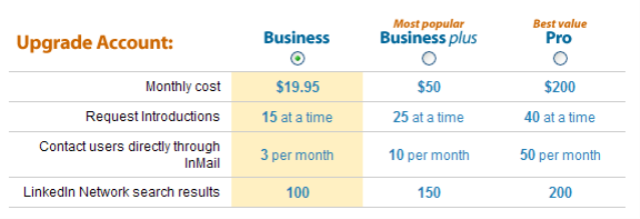
LinkedIn also attempted to make this easier with their “Introductions” feature, where you could send an “Introduction” directly to someone without knowing their address or using someone as a relay.  As a (free) basic user you got 5 of these “Introductions” that you could use at any one time – or you could upgrade (as shown on right) to get more Introductions.  I also did use this service as a way to connect to an ex-colleague and it worked fine.

However, while LinkedIn had this requirement to establish a connection, competitor Xing (formerly OpenBC) did not… and then of course Facebook and MySpace do not, either.   With a zillion new social networking services seeming to be announced each week, I suppose it was inevitable that this email address requirement would come to be seen as a barrier and was perhaps impacting LinkedIn’s take-up rate.

In any event, the email address requirement seems to be completely gone today.

Maybe it’s a glitch, but just this morning I accepted a LinkedIn invitation and, as I often do, browsed the person’s connections to see if I knew anyone.  I did, and so I viewed the profiles and clicked on the “add this person as a connection” link that appeared on screen after the text “Do you know this person?”  I did this three times.

It was only then that I realized that I had never provided any email addresses.  My invitations just went off.  Thinking it was an error, I looked up two ex-colleagues whose email addresses I no longer have and sent them invitations.  Same thing.  No email address required.

On the one hand, I don’t mind the change since it does make it easier to connect with people – and all the other services don’t impose that requirement.  But the other part of me says… uh, oh… now anyone inside of LinkedIn can send me a connection invite without doing any work to find my address – will I now be spammed by more people that I don’t know?

We’ll see… if you are a LinkedIn user, odds are that if this is true you’ll probably be seeing more connection invitations!

Technorati tags: ,

twitter.com/felch and the knee-jerk action of reciprocal "friend adding" – are people just looking for "friends"?

Yesterday I received the standard email that Twitter users get telling me that someone named “felch” had added me as a friend and indicating that I could follow the link http://twitter.com/felch (now dead but worked yesterday) to add the person back as a friend.  Not having a clue who it was, I naturally followed the link and, as I twittered, found that this person had added 7812 friends!  Huh?   Why would you do this?  How could you realistically follow updates from some 8000 people?

I became a bit more suspicious because there was no personal information there about whoever “felch” was and there were only 4 updates with one or two words that were basically trivial or meaningless. Unable to see any reason whatsoever to add this person as a “friend” so that I would wind up following their updates, I didn’t add them…

But at least 929 people did!

That’s the number of “followers” the account had when I noted it yesterday.  I have no idea how many followers the account ultimately had. I was hoping to catch a screenshot to include here, but that account is no longer there… either removed by Twitter admins or, I suppose, removed by the person who created it. (My bet is on the admins, but you never know.)  Why did someone do it?  Was it an experiment to test how many people would blindly add friends?  Was there some other SEO purpose?  Or was someone just bored and looking for something to play around with?

And what about those 900 people – why did they just add someone who: a) they did not know; b) provided no information about themself; and c) seemed to have nothing to offer so far?

Now I suppose I should put it in perspective… at the time I noticed, 6,883 Twitter users had not added “felch” to their friend list.  Of course some may not have yet seen the email and perhaps did later. But if we take those numbers as they were, it amounts to about 12% of the people “felch” added doing a reciprocal add of “felch”.  So the vast majority did not (at the time I noticed)… but 12% did.

Why?

Is it because of the natural sense of reciprocity?  (i.e. if you are so kind as to be a follower of me then I should be a follower of you)   Is it because people are still experimenting with Twitter and so are just adding people who add them?  Is it because people saw no harm in adding someone else to the list of people they follow?  Is it perhaps because it was very obvious that “felch” was new to Twitter and so there was an assumption that he/she might soon start posting real information?  Is is because people just want to have more “friends”? Why?

For my part, I only have a limited amount of “attention” that I can give to things and with so may things clamoring for my attention I am very picky about the amount of “attention clutter” around me.  If you look at my twitter page, there is an assymetry of attention there…  I currently follow 59 people and (for whatever reason) have 93 followers.  For some reason, I didn’t add 34  people.  Now it could be that the email telling me they added me is still in my queue.  It may be that I went to their page, found that I don’t know them, and just didn’t seen any updates of interest to merit adding them at that time.  It may be that when the email came I was just grumpy and not feeling like adding anyone. I don’t know. 

What I do know is that I hardly have time to scan all the other information coming at me in so many ways.  If anything, I am constantly trying to reduce and streamline my information flows to make them more efficient and useful.  So before I do something that is going go take away some attention, such as adding a Twitter friend or adding a RSS feed to my reader, I do give it some thought.  Is it really going to help/amuse/inform me?  Or do I know the person?

But it would seem that some percentage of people just click “add” when offered Twitter friendship.  Why?

ecademy – joining yet another business-focused social networking site (and doing so because of a Skype public chat)

Today my friend and fellow blogger Alec Saunders invited me to join ecademy.  I hesitated and almost just deleted it.  I’ve been a LinkedIn user for something like 3 years.  I’ve had a Xing (OpenBC) account for about that long as well, although I don’t use it as much.  I’ve recently joined Facebook and I still have an Orkut account floating around from when it first launched in 2004.  There’s probably a few others out there that I joined at some point and have now forgotten about.

Why do I need yet another membership in yet another social networking site?

If anything, I need fewer and to just focus my networking there. So my inclination was to simply decline the invitation (well, just delete the email). 

So what stopped me?  Why did I actually click the link and join ecademy?

Basically, because of a Skype public chat.  Well, two Skype public chats really.   Ever since Skype rolled out the beta for Skype 3.0 back in November or so, there have been a number of us who have remained logged in as participants in a public group chat that Jaanus Kase started up from the Share Skype blog and then a second public chat started up by Phil Wolff over at Skype Journal. These chats are “persistent” in the sense that you basically never leave them unless you click the “Leave” button or are ejected by the host. (Jaanus occasionally “cleans up” his chatroom by ejecting people who haven’t been participating, primarily because there’s a limit of 100 participants and its usually at the max with others looking to come in.)  Discussion goes in spurts, sometimes without any discussion for days… and then a whole flare up.  I read it every now and then and contribute from time to time… it’s just a background thing that actually winds up providing some great info for my main line of work (VoIP).

So what was that got to do with ecademy?  Well, one of the other participants in both chats since those early days is a gent named Julian Bond, who is… well… the CTO of ecademy!  (Gee, I’ve noticed a number of CTO-ish types in these public chats… might have a wee bit to do with being charged with evaluating emerging technology….)

So just as I was about to delete Alec’s invite, my brain thought “Hmmmm…. isn’t that the site that Julian Bond is involved with?  Maybe I should check it out.  Hmmmm.”

In the end, it so often does come down to recommendations from “people you know”.

Will I stay there?  Or will I check it out for a bit and then just go back to using the other sites?  I don’t know… time will tell.

In the meantime, if you are an ecademy user (and I know you) feel free to add me as a connection.   I’d also love to hear why you use ecademy versus the various other ones out there.