 At what point does all the information sharing in Facebook (and other social media) that is now visible to your co-workers cross over from being helpful in building connections between employees and move into feeling like a somewhat creepy invasion of privacy?
Right now we are living through a grand experiment in blurring the lines between personal and business lives…. between “friends” in the traditional sense, “friends” in the local community, “friends” we’ve met online and “friends” who are co-workers (and in some cases “friends” who are vendors, customers, etc.).
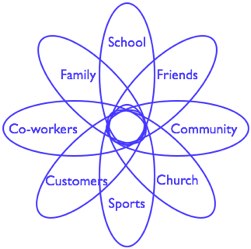 Sure, those lines have always been blurred in some fashion. Many times the people we work with are some of our closest “friends”. For many people who work in jobs in a local community, the intersection of their “friends” between employees, customers, and people they know in the community is very high. The same people come into their store that they see at a local sports game… or see at the local school… or go to the same church with… or see at a local bar.
For others, the intersection may be quite smaller. Co-workers may be far away. The job may have little or no connection to the local community. Family may be scattered all over the region, country or globe. “Friends” may be fewer or may be farther apart – or may be more online. In larger communities, especially, you may go to a church on the other side of the city and have kids in a sports league in another part of the city and your office may be in yet another part of town.
The degree of the blurring has a lot to do with the size of the local community you live in and the degree of your connection to that community. You may not attend a church… or play in a sport (or have kids that do)… you may not have kids and not have the school connections.
The point is that we’ve typically have different groups of people with whom we’ve shared different pieces of information. We know people in different “contexts” and share information with them in that context and often that context alone.
This is particularly true with the divide between our “work” and “personal” lives. Sure, we’ve always shared some parts of our personal life inside the walls of our “work” environment. We’ve talked to our co-workers… gathered at water coolers or in break rooms or cafeterias. Some people have shared very openly about what they are doing and we’ve learned much about their overall personality. Others have remained very private and shared virtually nothing. To some degree, we all have a facade that we construct that is how we appear to our co-workers.
The wall between work and personal lives has been there.
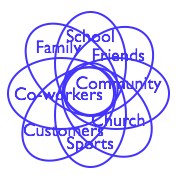 That wall is being demolished, though, along with all the other walls, in the new world of social media. We typically have only one Facebook account… we have one Twitter account… we have one MySpace account… and so on. We add “friends” who we know in various contexts to the same account.
Think for a moment about who you have added as Facebook “friends” (assuming you use Facebook). I know my list contains at least this:
- people who have been long-time friends in the traditional sense of the word
- people I know through activities related to VoIP/communications
- people I know through activities related to information security / VoIP security
- people I know through activities related to marketing / PR / communications / blogging / podcasting
- co-workers from my current employer
- co-workers from previous employers
- several industry analysts
- developers / programmers I know from various projects
- people I met while living in Ottawa, Ontario, and Burlington, VT
- people with whom I was involved starting up a curling club in VT
- a couple of extended family members
- an increasing number of people I grew up with back in the 70s and 80s, some of whom are probably wondering what in the world it is I do now
- people I’ve met at various conferences and became friends with
- a few people from Keene, NH, where we moved this summer
- other people I’ve met randomly in some context and become friends with
It’s a diverse list of people… and yet they all see the same information in my Facebook NewsFeed. They see the same
status updates… they see the same photos I post… the same Notes I import… the same del.icio.us bookmarks… the same videos I create.
The many different contexts are blurred into one.
Now maybe this is a great thing… we all get to learn more about each other – and the person behind the facade that we construct for each context. Or maybe are we learning too much. Where is the line?
Going back to my original question at the beginning… within Facebook the “25 random things about me” meme seems to be going strong in recent weeks, at least among the people to whom I am connected on Facebook. You know, it’s the “here are 25 things about me that most people don’t know”. We went through a whole string of memes like this out in the blogosphere a few years back and now and then they keep surfacing.
Anyway, the few posts I have had time to read in Facebook lately have actually been quite fun to read. I’ve learned a lot about some of the folks… remembered old stories… learned new ones. Some have been discreet in the info shared… and some have been more revealing than I would personally be.
It’s that latter bit that got me thinking about all of this. What if the person sharing the “revealing” information is a co-worker? Do we understand yet how (or if) this changes our relationships? Do I gain more respect learning of a serious childhood illness now overcome? Do I lose respect for that co-worker when I learn of the drunken binges they go on each month? What if I don’t like their politics or religion? Does any of this change the way I interact with the person? On one level, how can it not change my views of that person? – but can I/we move beyond that?
Have our “culture” and “conventions” caught up with the degree of information our tools now let us share?
Where is the line between information we share with co-workers and our “personal” lives? Is there even a line? Or is the very concept of such a line just a quaint anachronism of another era?
P.S. For my own part, I assume there is no line and continue to follow the mantra: “Never put online (anywhere) anything you would not want to appear on the front page of the New York Times.” Perhaps that limits my “openness”, though…
If you found this post interesting or useful, please consider either subscribing to the RSS feed or following me on Twitter or identi.ca.
Technorati Tags:
facebook, socialmedia, social media, culture, privacy, friends, microblogging
I think you raise a lot of interesting questions about the ramifications of all this interaction. And I’m with you — I have “friends” on facebook who are childhood friends, current friends, relatives and blog readers whom I have never met.
I do use my privacy setting to monkey with who gets to see what. Not really sure I want my blog readers to have the same access to my kids’ pictures as my mom does on facebook, for example.
And I never post anything, as you say, that I wouldn’t want on “the front page of The New York Times.” I save my private observations for private functions such as the message feature on Facebook.
I think all this interaction is good for me from a business sense. I’m a journalist, and I know that in the past readers felt very distanced from the newspaper. I think social media really helps bridge that in way that beneficial.
Does it make for some weird moments … yes. But I think most people still have their “inner circle” of real friends who get the nitty-gritty.
And sometimes it’s more fun sharing with a “stranger” because you care less what they think.
I’m fascinated by how people are navigating this dance between revealing and concealing now that social media has exploded.
It’s easy to draw the line at drunken rants/photos, but as you point out what about politics or religion? We tend to like people more that are the same – or similar – to us. Sharing more personal perspectives can help or hinder relationships in that respect.
I’m curious as to what other people are experiencing as they navigate this new social openness…
I created new Facebook and Twitter accounts yesterday. Your comments are very interesting. Some of your concerns have held me back from trying these new mediums for communication.
The line on my new Facebook account that said “Donna has 0 friends.” was a very powerful psychological motivator to expand the account quickly and exponentially. It was kind of like High School all over again. Oh, and there to tantalize me were faces of High School aquaintances waiting for me to reach out and “poke”, “nudge” or be rejected by all over again.
There were so many descisions to make. Should I let the world know my political affiliations? Should I look like a wimp and leave it blank? Would I confess in public my favorite mind-wasting television shows? My personal shyness came through as I posted a picture of my cat instead of myself. ( I usually have the camera. There are very few pictures of me.)
I think the ultimate question, though Is how we choose to use these tools. For that, the same old values apply. Are the things we post honest, respectful and responsible? Are our online relationships just to feed our pride and egos or are they sincere and purposeful? Do we respond to others with the same kindness and mercy we expect from them? Perhaps “Post to your friends as you want them to post to you.” is the golden rule of the new global village.
Dan,
I’ve been pondering the same question. My Facebook account has organically grown into mainly “friends” or friendly business associates. I like it that way. I share more personal info. My Twitter account on the other hand is more focused on professional relationships and professional conversations probably because most of my “friends” are not even using it. I am careful on both platforms to not mention too much personal info about my kids because I want to respect their privacy. And hopefully my “friends” will keep the drunken adventure stories to themselves. 🙂
Hey Dan! Heard you speak about this on For Immediate Release and I was immediately intrigued. I’ve been working with some other folks on a model that addresses some of the same ideas, from a slightly different angle. I’ve blogged about it a couple of times, most recently here:
http://mediadriving.com/2009/01/29/who-are-they/
The questions you raise here are a little different — you’re dealing more with context whereas the “connection continuum” we’ve been working on is more about the type of connection and intention for connecting. I’m going to think more about what you’ve said here and think about how it might influence our model. And if you have any thoughts about our model or how these groups of ideas might fit together, I’d LOVE to hear them!
Thanks, – J.
Sooner or later we’re going to work out it’s not a good idea or it is and by then it’ll be too late. Be interesting to see what we all think about it 5 years from now…
Hi Dan –
I like your visuals of this – the overlapping spheres of interest is a really hard question for me. There are some spheres that are special to us partly because they are walled off from the rest of our lives. I kind of equate it to people’s summer places here in New England. A fair number of people have places on the Cape, in NH, Vermont, or Maine and it is a world apart from their day to day lives. It is a very special thing to be invited into someone’s summer sphere because part of its appeal is that it is a world apart. So there is value in the separation…but I wonder if that can last. I hope so.
Great post!
Rachel
PING:
TITLE: The Challenging Intersection Of Facebook And Religion – And The Blurring of Public and Private Lives
BLOG NAME: Disruptive Conversations
Facebook creates a challenge when it comes to religion (and politics) for many of us who also use Facebook in a professional / work environment. I fervently believe that a person’s religious views are their own private matter. Each of…
PING:
TITLE: 5 Years of Using Twitter – Some Thoughts on That Anniversary…
BLOG NAME: Disruptive Conversations
It was five years ago today that I started using Twitter as what would come to be known as “@danyork”. October 24, 2006. I remember the date purely because “10/24” in the US way of writing dates is an über-geeky…
PING:
TITLE: Does Facebook Change a 25th High School Reunion?
BLOG NAME: Disruptive Conversations
What if you went to a “reunion” already knowing a great bit about the people you are reconnecting with? Would it allow you dispense with all the initial “small talk” and move on to having deeper conversations? Would it make…
PING:
TITLE: Re-examining how I use Facebook – and again the blurring of our lives
BLOG NAME: Disruptive Conversations
Who do you “friend” on Facebook? And how do you resolve the tension between private and public interaction? It’s funny how synchronicity works some times. Last week I was thinking about writing a post about how my use of Facebook…