Category Archives: Facebook

O’Reilly – Facebook apps aren’t as hugely successful as some would like you to think!

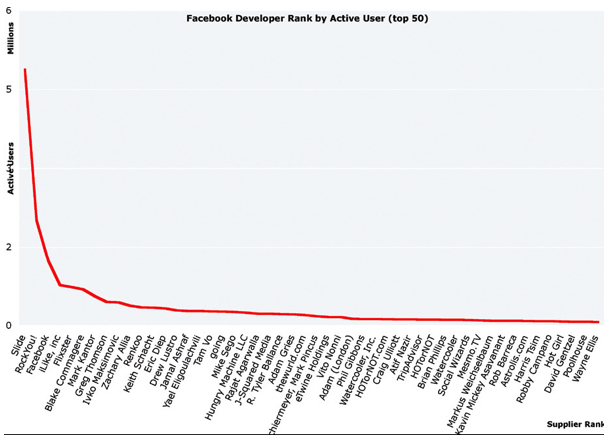
200710081649Over on his O’Reilly Radar blog, Tim O’Reilly pierced a bit of the Facebook application hype with his post last Friday: “Good News, Bad News about Facebook Application Market: Long Tail Rules” where he notes this:

The good news has already been widely disseminated: there are nearly 5000 Facebook applications, and the top applications have tens of millions of installs and millions of active users. The bad news, alas, is in our report: 87% of the usage goes to only 84 applications! Only 45 applications have more than 100,000 active users.

He subsequently noted that he did mis-use the “Long Tail” term a bit… the story here really is that the “short head” is where all the action is. Tim is careful to note:

This doesn’t mean that Facebook won’t become an important platform for developers, just that a throwaway Facebook app is not the ticket to quick riches. Embracing the Facebook opportunity requires more than just optimism.

Translation – all of those out there hyping the Facebook platform as the greatest invention since sliced bread need to slow down a wee bit. The Facebook platform is very cool and is an evolving application platform. It’s definitely a space that people need to pay attention to… and it very well may be a place where your application may be a runaway hit – but it may not bring the instant riches that your startup’s business plan envisions. At least… not yet.

Good to see this kind of data emerging and I would expect that we’ll start seeing similar reports emerging from the mainstream analyst houses. Kudos to O’Reilly for being the first one I’ve seen out there on the topic.

P.S. I should, of course, note that Tim’s blog post references the report published by O’Reilly Research: “The Facebook Application Platform” which is available for purchase for $149.

Technorati Tags: , , , ,

Awakening to a “social media birthday”…

As has been commented on by others in this space, social media brings a new element to birthdays. Already, messages are appearing on my Facebook wall, and Skype contacts have been sending me birthday notes as well. (Helped to a degree by the fact that many of the folks so far are in Australia or Europe, so the day is already well underway for them.) It’s quite nice, really… it definitely puts the “social” aspect in the media.

While I share Christopher Penn’s concerns about privacy and giving away your birthdate, I will admit that today is my birthday. Because of those privacy concerns, I tend NOT to post the year of my birth, although that’s not terribly hard to figure out due to the fact that there is already so much information online about me. I also seem to have included it in my Skype profile (was I required to do so?) and so my Skype contacts understand that this particular birthday is a bit more of a milestone than others. (Hint for the rest of you – I was actually born during a Star Trek episode during the original run of the original series. Trekkie’s can figure it out from there… )

Thank you to all who have sent their greetings!

Technorati Tags:

FacebookCamp Montreal – Wednesday, November 7, 2007

200710041857In the spirit of BarCamps and PodCamps, I was pleased to see that there will be a “FacebookCamp” up in Montreal, Quebec, on Wednesday, November 7, 2007. It’s from 4:00pm into the evening and is for people interested in developing apps for Facebook. As I write this, there are 57 confirmed guests and 36 people who are “Maybe Attending”! If you are in the Montreal area and interested in developing apps for Facebook, do check it out:

I am in that “Maybe Attending” category myself. Montreal’s only about 1.5-2 hours (and a border crossing) away, so I may shoot up the highway for the event.

Technorati Tags: , ,

LinkedIn succumbs to the Facebook effect and adds a profile photo

200709291456-1One of the reasons some people have cited about going over to Facebook is that Facebook allows you to have a photo on your profile. LinkedIn always seemed to resist, with some people mentioning that it was more “professional” in that you weren’t getting into seeing how people looked.

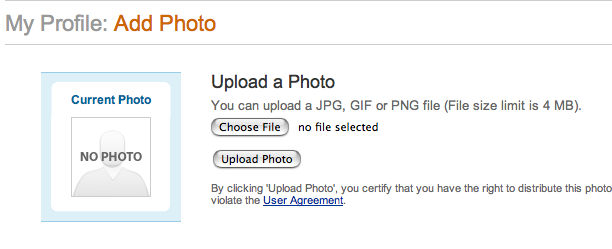
Whatever the past rationale, LinkedIn announced on their blog Thursday that users would be able to upload profile photos. The interface is pretty simple. In your “Accounts and Settings” area under “Profile Settings” there is a link for “My Profile Photo”:

200709291455

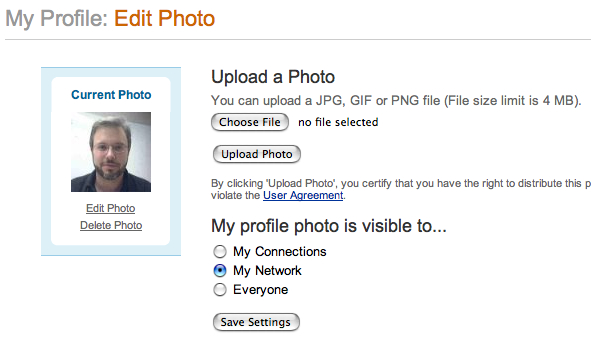
Add in a photo and you now have the option to display that photo to your contacts or to display it publicly:

200709291456

The LinkedIn blog entry goes into more details. Personally, I’m quite glad to see it primarily because over time I find I’ve lost track of who some of my LinkedIn contacts are and it would be very nice to have a photo to remind myself of exactly who they are. Also, in a global namespace with people having similar names, it’s nice to have the visual confirmation when searching that the profile belongs to the person you know. Now it will be interesting to see how quickly people do or do not upload photos.

Technorati Tags: , ,

Facebook brings the twin taboos of politics and religion into the workplace

200709240904Some time back I became a Facebook “friend” with someone I had known professionally for several years. I did not work with the person all that much, but had great respect for the person based on the several dealings I had had with them. However, now that we were “friends” I was almost immediately exposed to two pieces of information that they had included in their Facebook profile: political affiliation and religion. As it happened, this particular person’s views were pretty much completely opposite to my own and before I could really think about it I experienced a deep knee-jerk reaction of “Oh, you’re kidding, he/she is not really one of them?” For a brief moment, until my brain could re-engage, my respect for that person plummeted through the floor. A moment or two later, the rational side of my brain kicked in and reminded me that I had had a great amount of professional respect for the person 10 seconds before and nothing had changed that should have altered that. Still, there was that deep emotional response.

Politics? Religion? In the workplace? With professional colleagues? Huh?

At least here in North America, those are two topics that are generally taboo in the work environment. Verboten. In fact, in most areas you are not legally allowed to ask employees or potential employees about those topics. Within a work place there of course may be lunchroom discussions about recent politics and so you may learn of others viewpoints. Religion might come up, but again probably with people with whom you work closely.

But with customers? Or partners?

Never. At least in my experience.

And why should it come up, really? When you are buying a product/service from someone, or selling it to someone, what do politics or religion matter? (or gender or race?) If you are partnering with someone to deliver a service/product, again, why does it matter? What matters is whether both of you can work together and deliver the product/service – and presumably make some money through the deal.

Religion and politics should not matter in business dealings.

Now, of course, there are “business directories” that many churches offer trying to connect people within the church community, but that’s a different matter as it is within that community and trying to help each out. There are also websites out there that can help you steer your business toward companies with similar views as yours. But in general, the political leanings and religious preference of a supplier or customer do not factor into the normal course of business.

Yet here we are in Facebook choosing (or not) to provide all that information to (potential) customers.

I recognize that there are a good number of folks out there who are apathetic about all things related to politics and/or religion. They don’t care at all about what someone’s religion is or what their politics are. I’ve met many. Often they say they don’t care about religious/spiritual issues, haven’t attended a church (or spiritual service) in years (or ever) and haven’t voted in any elections. Religion and/or politics mean nothing to them and so they take no offense or don’t even notice when someone states their political or religious preference.

Leaving the completely apathetic aside, though, most people have some opinion about politics and some view about religion/spirituality. The stronger those views, of course, the more deep the emotional reactions. A hard-core liberal in the US may have (or at least appreciate) a bumper sticker “Friends don’t let friends vote Republican”. A hard-core conservative may view all liberals as traitors and the source of all the country’s problems. A strong “born again” Christian may see that the problems of the world are because people have not accepted Jesus Christ as their lord and savior and need to do so. A strong atheist may see that the problems of the world are because of the very existence of religion and that it is the root of all evil. These are deeply-ingrained views:

Politics and religion are part of our core identity that helps form who we define ourselves to be.


When that part of our identity is confronted by a polar opposite, we naturally react. Conservative Christians will have second thoughts about atheists, and atheists will have second thoughts about conservative Christians. Ultra-liberal Democrats will instinctively distrust ultra-conservative Republicans – and vice-versa. It’s just part and parcel of being human and building these beliefs into your identity.

Within the work environment, though, these twin areas of politics and religion have not been part of normal discourse… but yet, if you choose to fill out those fields in Facebook, they are suddenly exposed to all your “friends”.

It works the other way, of course. Some time back I added another “friend” whose politics and religion closely aligned with me. Again, without any rational thinking, the thought popped into my brain “Oh, he/she’s that. No wonder why we got along so well.” In the mass of people out there, we seek out those communities of like-minded people… those affinities that we can use to build stronger connections.

Which is why having fields for politics and religion make so much sense for Facebook’s original audience of college students. You are about to land in a campus of 10,000 people, of whom you know basically no one. How do you find new people? How do you find potential friends? Searching on “interests” is one way… but searching on political views or religion is another great way. Odds are that if they claim a similar religious view (or upbringing), they probably have a similar world view to yours. Likewise if they have similar political leanings, you probably have more in common upon which to potentially build a friendship. It makes total sense in that environment. Likewise, if Facebook is just used among your “friends”, odds are that they probably already know these views about you. But today we are overloading the term “friend” and so now it encompasses true “friends”, family… and business contacts.

So it’s one thing to share political/religious info with friends, family and classmates, but in business? I don’t know… on the one hand there is the greater “transparency” and the chance to make connections with other people. On the other hand, there is the strong chance of potentially alienating others.
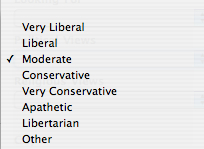
200709240851In any event, the fields are there in your Facebook profile if you choose to fill them out (and many people seem to during the process of signing up). Of course, you are limited to the choices that Facebook provides for politics. They don’t offer the “It’s Complicated” choice that they have for relationships, which would be quite useful. The “Religious Views” field is free text entry, so you can really write whatever you want there. It seems to me that you really have four choices:

  1. Leave them blank – probably the safest choice, but potentially then losing out on some networking possibilities.
  2. Enter generic choices – you could be safe and choose “Moderate” and write in something vague for a religion.
  3. Fill out only one – you’ll see I have a political entry but not a religious entry.
  4. Fill them both out – embrace full transparency and let the world know (or at least your “friends”) your affiliations and beliefs.

To me this is just yet another one of those areas where we don’t fully understand the full impact of the profiles of Facebook and, in fairness, all the other social networking services. In the rush to join these services, we just fill out all sorts of information, not necessarily taking the time to think about the potential impact exposing that information may have.

What do you think? If you are a Facebook user, have you filled out those two fields? Do you think people should in an effort to be more transparent? Do you think we understand the full ramifications of exposing information like this? (Or do you think the issue I raise here is really not an issue?)

Technorati Tags: , , ,

Facebook brings the twin taboos of politics and religion into the workplace

200709240904Some time back I became a Facebook “friend” with someone I had known professionally for several years. I did not work with the person all that much, but had great respect for the person based on the several dealings I had had with them. However, now that we were “friends” I was almost immediately exposed to two pieces of information that they had included in their Facebook profile: political affiliation and religion. As it happened, this particular person’s views were pretty much completely opposite to my own and before I could really think about it I experienced a deep knee-jerk reaction of “Oh, you’re kidding, he/she is not really one of them?” For a brief moment, until my brain could re-engage, my respect for that person plummeted through the floor. A moment or two later, the rational side of my brain kicked in and reminded me that I had had a great amount of professional respect for the person 10 seconds before and nothing had changed that should have altered that. Still, there was that deep emotional response.
Politics? Religion? In the workplace? With professional colleagues? Huh?

At least here in North America, those are two topics that are generally taboo in the work environment. Verboten. In fact, in most areas you are not legally allowed to ask employees or potential employees about those topics. Within a work place there of course may be lunchroom discussions about recent politics and so you may learn of others viewpoints. Religion might come up, but again probably with people with whom you work closely.

But with customers? Or partners?

Never. At least in my experience.

And why should it come up, really? When you are buying a product/service from someone, or selling it to someone, what do politics or religion matter? (or gender or race?) If you are partnering with someone to deliver a service/product, again, why does it matter? What matters is whether both of you can work together and deliver the product/service – and presumably make some money through the deal.

Religion and politics should not matter in business dealings.

Now, of course, there are “business directories” that many churches offer trying to connect people within the church community, but that’s a different matter as it is within that community and trying to help each out. There are also websites out there that can help you steer your business toward companies with similar views as yours. But in general, the political leanings and religious preference of a supplier or customer do not factor into the normal course of business.

Yet here we are in Facebook choosing (or not) to provide all that information to (potential) customers.

I recognize that there are a good number of folks out there who are apathetic about all things related to politics and/or religion. They don’t care at all about what someone’s religion is or what their politics are. I’ve met many. Often they say they don’t care about religious/spiritual issues, haven’t attended a church (or spiritual service) in years (or ever) and haven’t voted in any elections. Religion and/or politics mean nothing to them and so they take no offense or don’t even notice when someone states their political or religious preference.

Leaving the completely apathetic aside, though, most people have some opinion about politics and some view about religion/spirituality. The stronger those views, of course, the more deep the emotional reactions. A hard-core liberal in the US may have (or at least appreciate) a bumper sticker “Friends don’t let friends vote Republican”. A hard-core conservative may view all liberals as traitors and the source of all the country’s problems. A strong “born again” Christian may see that the problems of the world are because people have not accepted Jesus Christ as their lord and savior and need to do so. A strong atheist may see that the problems of the world are because of the very existence of religion and that it is the root of all evil. These are deeply-ingrained views:

Politics and religion are part of our core identity that helps form who we define ourselves to be.

When that part of our identity is confronted by a polar opposite, we naturally react. Conservative Christians will have second thoughts about atheists, and atheists will have second thoughts about conservative Christians. Ultra-liberal Democrats will instinctively distrust ultra-conservative Republicans – and vice-versa. It’s just part and parcel of being human and building these beliefs into your identity.

Within the work environment, though, these twin areas of politics and religion have not been part of normal discourse… but yet, if you choose to fill out those fields in Facebook, they are suddenly exposed to all your “friends”.

It works the other way, of course. Some time back I added another “friend” whose politics and religion closely aligned with me. Again, without any rational thinking, the thought popped into my brain “Oh, he/she’s that. No wonder why we got along so well.” In the mass of people out there, we seek out those communities of like-minded people… those affinities that we can use to build stronger connections.

Which is why having fields for politics and religion make so much sense for Facebook’s original audience of college students. You are about to land in a campus of 10,000 people, of whom you know basically no one. How do you find new people? How do you find potential friends? Searching on “interests” is one way… but searching on political views or religion is another great way. Odds are that if they claim a similar religious view (or upbringing), they probably have a similar world view to yours. Likewise if they have similar political leanings, you probably have more in common upon which to potentially build a friendship. It makes total sense in that environment. Likewise, if Facebook is just used among your “friends”, odds are that they probably already know these views about you. But today we are overloading the term “friend” and so now it encompasses true “friends”, family… and business contacts.

So it’s one thing to share political/religious info with friends, family and classmates, but in business? I don’t know… on the one hand there is the greater “transparency” and the chance to make connections with other people. On the other hand, there is the strong chance of potentially alienating others.

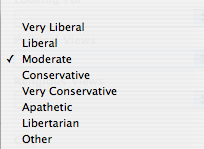
200709240851In any event, the fields are there in your Facebook profile if you choose to fill them out (and many people seem to during the process of signing up). Of course, you are limited to the choices that Facebook provides for politics. They don’t offer the “It’s Complicated” choice that they have for relationships, which would be quite useful. The “Religious Views” field is free text entry, so you can really write whatever you want there. It seems to me that you really have four choices:
  1. Leave them blank – probably the safest choice, but potentially then losing out on some networking possibilities.
  2. Enter generic choices – you could be safe and choose “Moderate” and write in something vague for a religion.
  3. Fill out only one – you’ll see I have a political entry but not a religious entry.
  4. Fill them both out – embrace full transparency and let the world know (or at least your “friends”) your affiliations and beliefs.

To me this is just yet another one of those areas where we don’t fully understand the full impact of the profiles of Facebook and, in fairness, all the other social networking services. In the rush to join these services, we just fill out all sorts of information, not necessarily taking the time to think about the potential impact exposing that information may have.

What do you think? If you are a Facebook user, have you filled out those two fields? Do you think people should in an effort to be more transparent? Do you think we understand the full ramifications of exposing information like this? (Or do you think the issue I raise here is really not an issue?)

Technorati Tags: , , ,

“Hi, my name is Dan. I am a screen shot addict.”

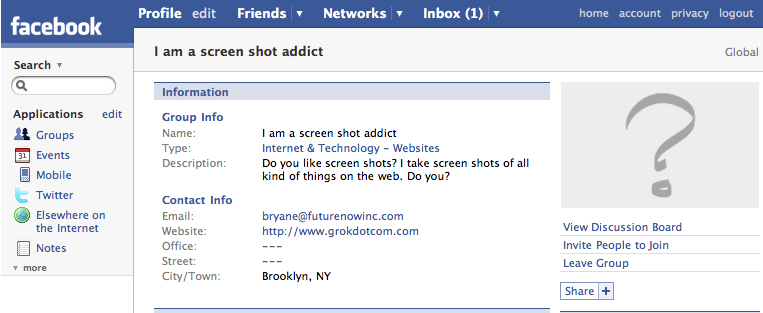
200709232007I had to laugh when I saw in my Facebook News Feed that several of my friends had joined a new Facebook group “I am a screen shot addict” (You must be a Facebook member to see the group). I laughed a bit more when I saw Betsy Weber’s blog post which in turn pointed me to the creator of the Facebook group, Bryan Eisenberg, and his post “Confessions of a Screen Shot Addict“.

You see, I am a screen shot addict. Always have been. Probably largely because I used to write a lot of courseware related to computer programs and so naturally I needed to illustrate those documents with screenshots. Now, I take screenshots galore for these blogs. I just like illustrating my articles with graphics… and screen shots are one of the best ways to do that.

On my Windows laptop, I was using TechSmith’s SnagIt and loving it. I was also using TechSmith’s Jing Project for quick screen shots that I wanted to reference in, typically, an IM conversation. Now that I’m on the Mac, I’ve got a wonderful built in utility (I love Shift+Ctrl+Cmd+4) and I’m also checking out Jing for the Mac.

So yes, I love screenshots… if you do, too, and are a Facebook user, feel free to “join the group“.

Technorati Tags: , , ,

Why is Facebook’s Application Directory Search so incredibly broken?

One of the greatest bits of buzz around Facebook these days is the application APIs, the “Facebook Platform”.  It’s also one of the most frustrating aspects from a user perspective.  Very often I’ll see on my News Feed that someone installed an application and I’ll think to myself that I should check out that app.  However, if I don’t do it right at that precise moment, well, the odds are that I won’t… because it seems next to impossible to find apps in the directory!

Has anyone else been able to successfully use the “search” feature in Facebook’s Application Directory?

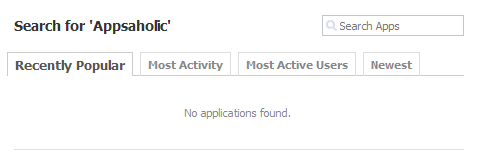
Take today… I saw on my Facebook News Feed at some point in the day that someone I know had installed the “Appsaholic” application.  Subsequently in a lunchtime conversation I wound up learning about this app enough that I got curious.  So I went to my Applications page inside my Facebook account and entered “Appsaholic” in the search box.  This was the result (click on image for larger version):

image

Oops.  I tried several other variations on the name to no avail.  Finally, I just went to Google and searched on “facebook apps-a-holic” which brought me to this article which gave me the application URL inside of Facebook.

Crazy.

Why should I have to go outside of Facebook in order to find an application? 

Unfortunately, this has been my experience several times on different days, and I find it a bit of a concern.  So much of developing an app for Facebook is about being found.  Obviously the viral path through newsfeeds is one way to be found, but the application directory is an obvious one.  If you make it to one of the provided lists, you’ll be found, but searching should work, one would think.

Have others experienced this problem?

(Now I would note that I couldn’t find any of the applications I’ve already installed when I searched in the directory – perhaps the issue is that the search engine is down itself.  If so, it would be best for Facebook to put up a statement that the search engine is having problems rather than just saying “No applications found.”)

Facebook fuels student revolt (and eventual victory) over new logo for Middlebury College

image Seems the students didn’t quite like the new logo their school came up with – and took to Facebook to mount a campaign against it! Today’s Burlington (Vermont) Free Press ran this article: “Middlebury Facebook revolt contributes to college logo revision“.  Unfortunately, the online version of the article doesn’t include the graphics, (Huh?  Free Press staff – why couldn’t you put the logos there?) but the dead tree version that I got this morning did… and I can see the students concerns.  The new logo, shown on the right, is much more “corporate” and looks like something more Canadian.  But I’m getting ahead of myself… here’s the background from the article:

In fall 2006, as they began to plan for a major fund-raising drive, college officials thought about coming up with a new logo. A review committee was formed, 10 design firms were considered, three finalists were interviewed, and the winner — the New York firm of Chermayeff & Geismar, which boasts a portfolio of prominent corporate and university brands — set to work.

The ultimate design — a stylized double leaf outline, reminiscent of maple — went through customary reviews. Like any proposed logo, it drew different reactions — some people liked it, some didn’t, but on balance the reaction was favorable, said Mike McKenna, the college vice president for communications who spearheaded the process.

This summer, as college officials were getting ready to order new stationery for the next academic year, the new logo was “unveiled” to the campus community. What happened next took McKenna and just about everyone else by surprise.

Students weren’t very happy when the new logo appeared on the website and so they started a Facebook group called “Just Say No to the Middlebury Logo“.  From the article:

Hundreds signed on to register their scornful, amusing comments about the double leaf. Some complained it looked too corporate, others that it was too much like Canada’s national symbol, or even that it evoked a marijuana leaf.

At least three students designed T-shirts parodying the logo, and Franco, who also runs her own blog, posted their images on July 11. Two played off the Canadian motif, and one — designed by student Alex Benepe, who helped Franco with the Facebook project — worked the logo’s “M” into an entirely new college insignia, “LaMe.”

Benepe said Franco’s creation “grew faster than any Facebook group I’ve seen.”

“In seven days, 777 people joined,” Franco said. That was about the time, she said, when the college administration changed course and withdrew the new logo for general use.

McKenna, who already had received plenty of feedback on the logo, said he hadn’t expected the Facebook reaction or the numbers. Roughly one-third of the college’s students signed on — in summertime, no less.

So one-third of the college’s students joined the group – in the summer

In the end, the Middlebury administration went back and revised the existing logo a bit. As the article says:

While the college administration would not make policy based simply on people going online to express their opinions, McKenna said, the opposition couldn’t be ignored, either. What he found heartening, he said, was the strength of students’ institutional commitment, along with the favorable comments about the college’s traditional, Latin seal.

imageThe college decided to keep using a slightly updated version of the school’s traditional “latin seal-style” logo on stationary, official documents, etc.  The new logo will be used on their 5-year fund-raising campaign that is going to reach out to the wider community.  (More information is available in Middlebury’s page on their Graphic Identity System and specifically their “About the process page“.)

Kudos to the Middlebury administration for working with the students – and somehow I expect we’ll see more of these type of stories coming out of Facebook activity!

Garrett Smith launches "Facebook Observer" web site…

image After stumbling upon the “Facebook Observer” site the other day, I was pleased to learn (from the About page) that the author was none other than Garrett Smith, who I have known in other contexts from his blog, “Smith on VoIP“.  He seems to have launched the site in early August, but I just noticed it recently.  So far he seems to have some good articles up there and indicates that he has the goal of  “becoming the destination for marketers and businesses in general to learn about how they can use Facebook for their own gain.”