Category Archives: Facebook

Facebook – Why can’t I schedule an event more than 2 months out? (Earth to Facebook: We’re not all students who only think a few days or weeks ahead!)

Here I was at the end of the work day just tying up a few loose ends.  One of the things I had on my list was to set up a Facebook event for O’Reilly’s Emerging Telephony conference, upon whose program committee I sit.  Given that we’re seeking speaking proposals, I thought that experimenting with Facebook might be an interesting way to get the word out within the tech crowd using Facebook.  However, I couldn’t create an event for the ETel conference.  Why not?

Because Facebook won’t let me create an event past October 2007!

Huh?

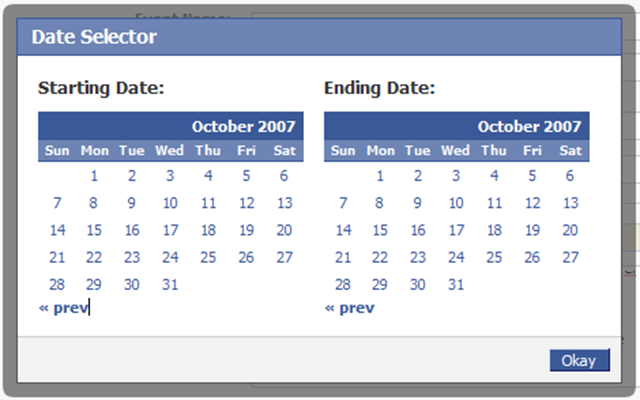
The conference is on March 3-4, 2008, and so I wondered if I was in trouble when I went to create an event and saw only this:

image

What’s missing?  (click for a larger image)  Yes, indeed… there’s no year in the start or end time.  Clue #1 that something was wrong.  My immediate reaction was that I was annoyingly going to have to click through the calendar “next” buttons to get to the right month.  So I started doing this and found, as you can see in the picture below, that Facebook events can’t be set later than October 2007!

image

At least, I could find no way to do so.  If someone else can, please do let me know.

Now, even though it was most of 20 years ago, I do remember life as a college student and I do recall that my “event horizon” for planning was really only the next few days or weeks.  If it was farther out, it simply never entered my brain.  I’d worry about that sometime later… after the next round of projects or papers were due.  So perhaps Facebook is based on that mindset… if it’s not within the next 2 or 3 months, you don’t care!  (And I realize that certainly not all students fit into this stereotype and that there are some students who plan farther ahead.)

However, if Facebook does seriously want to get into the business space, they definitely do need to open up this window a bit more.  I’ve got conferences and events I know I’m going to 6months… 12 months out.  Wouldn’t it be great to be able to network with other people planning to go to those conferences farther in advance?  Or if you are an organizer, wouldn’t it be great to be able to promote the event within Facebook?

Technorati tags:

Facebook: All your email belongs to us! (Inside of the walled garden… and do your recipients know that the Facebook ToS lets them do anything they want with your email?)

Back in May, when I wrote my “Facebook is a walled garden” post, I wrote this:

We’ve gone from the closed communities of email services to the complete openness of Internet e-mail and now seem to be returning back to those gated communities, with email/SMS helping keep us aware of updates. 

I was talking at the time how Facebook let you only send messages to those within Facebook.

Well, today Facebook took an interesting step.  As noted as in the Facebook blog, you can now send email to people on the outside who don’t have Facebook accounts:

If you’re like most people, you may have a few stubborn friends who haven’t joined Facebook…yet. This can make reaching friends complicated—there are some friends you can send a Facebook message, and others you have to email. Not anymore. Now, when you’re writing messages, you can send the message to people on Facebook, and to people not on Facebook.

Now you can enter a friend’s email address into the To: line when you send a message or share an album, and Facebook will email them the message. Your friends will be able to reply without signing up, and they will be able to see content you share with them. Keep in mind that all rules of privacy still apply; some Facebook content that you share (photos, groups, notes, etc.) won’t be visible to your friend.

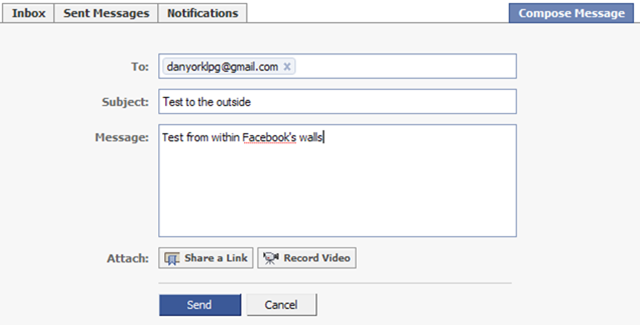
It does work, as you can see in the screenshot below (click for a larger image):

image
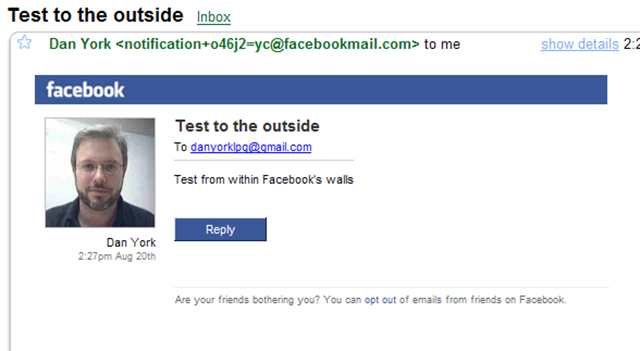
Over in my Gmail account, it comes out like this (click for a larger image):

image

The sending email address shown for my Facebook message is: “notification+o46j2=yc@facebookmail.com“.  I can reply back and the reply winds up in my Facebook inbox.

On the one hand, I applaud Facebook for allowing communication to go out through the walls and come back in.  However, two points:

1. You still can’t forward messages from inside Facebook out to external recipients. Perhaps this is part of the whole “privacy” thing, but there are times when it would be great to get something from inside out to someone on the outside; and

2. Do your external recipients realize that anything they send in becomes the property of Facebook?  The Facebook Terms of Service are still dated as of May 24th, and that’s well before I posted my note/warning about all your content belonging to Facebook.  Now I’m not sure what Facebook would realistically ever do with all the content… but I think it’s fair to be sure that people on the outside realize that whatever they send in becomes the property of Facebook to do with it whatever they want (if they so chose).

 The Facebook blog entry concluded with this:

As we continue to make Facebook more useful for everyone, these changes mean that there’s no need to switch between Facebook and email for your daily communication needs.

Translation:  Just use Facebook as your portal for everything.  No need to go out to those pesky Gmail, Hotmail, AOL accounts…

Luke, a Facebook engineer, is never using email again. Ever.

 But, of course, Luke is using email… just email inside of Facebook.  We’ve gone from walled gardens of email to open standards and then back into walled gardens of email.  Strange world we’re in.

Identitude – using your Facebook account for an OpenID identity!

imageWhat if you could use your Facebook login as a source for an OpenID identity?  Courtesy of a Facebook status update by Aswath Rao, I learned of Identitude, which does exactly that.

Here’s how it works.  First, within the walls of Facebook, you add the Identitude Facebook application to your profile.  After you do that, you claim your OpenID URL essentially as you would with any other identity provider. For instance, my Identitude OpenID identity is:

http://danyork.identitu.de

(Note that the URL ending in “.de” (Germany) looked strange to me until I realized you are supposed to read the whole URL similar to “del.icio.us”.)

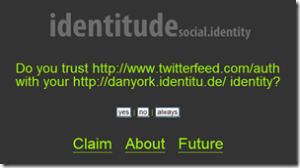
So now, when I go to any site that allows me to login via Open ID (directories here, here and here), I simply enter my Identitude URL as my user name.  Identitude, as the Identity Provider, then checks with Facebook to see if I have approved sharing my identity with this site.  Assuming I’m logged into Facebook already, I’ll then get this screen below (when I went to Twitterfeed.com and logged in with my OpenID):

image

where I will then approve the usage of my identity with this site.  If I click on “yes” (for a one-time approval) or “always” I will then be logged into the site (Twitterfeed in this example) and be able to use the site’s services. 

The developer, Armand Du Plessis, posted his own explanation in the (internal to Facebook) forum for the app:

It creates a new OpenID but uses Facebook for authentication and identity details.

You can use <yourname>.identitu.de on other sites (or Relying Parties) that supports OpenID. You’ll be authenticated with Facebook and if the site requested Simple Registration details like your name etc, it pulls that info from your Facebook profile.
It’s still a prototype but the next version will be documented better 🙂

On the privacy side. The only information stored is the Facebook identifier used to link the user to an OpenID and to lookup the user again later and a session key as required by the Facebook API.

The process flow is basically something like :
You enter your Identitude OpenID on a Relying Party (RP) site e.g. jyte.com.
The site look up your OpenID server (Identity Provider) by parsing that OpenID url you supplied above and it resolves to
http://identitu.de/openid in this case.
It establishes a session with the IP which is a small process and asks it to verify you.
At this stage if you are logged in to Facebook I will just lookup and supply your details(first asking you to confirm that you trust the RP with your details) If you’re not logged in it will first ask you to login to Facebook before sending the info back.
The RP will either log you in to their site or register you.

Okay, “so what?” you may be saying, what does this really do for me?

Well, as I’ve written about before, services like OpenID are trying to address the issue of having to login to each and every website with a different username and password.  Or, for instance, having to fill in your user information to comment on a blog (like this one).  What if you could have just one identity that you used across all of the various websites you use?  (Or maybe two identities – say, one for work and one personal. ) And what if that identity could be secured so that you only had to remember a single password – yet that password wasn’t shared across all those websites? 

That’s the whole concept behind OpenID.  (Here’s a great screencast from Simon Willison that explains it in more detail and here’s a Security Round Table podcast with which I was involved that dived into the issue as well.)

You can get an OpenID identity from any of a zillion identity providers.  You can use your AOL screen name.  You can use your LiveJournal account.  With a tiny bit of HTML code, you can use your own domain name.  You have many different choices.

Now… with this Identitude application inside of Facebook, you have one more choice: your Facebook account.  Since most Facebook users will probably already be logged into FB as a part of their regular daily activity, it’s very easy to then login to other sites via OpenID. Just one authorization screen and you are logged into the site in question.  (Now, the same could be said of using AOL or LiveJournal for an OpenID identity because AOL and LJ users are typically logged in on a daily basis.)

So you have one username and password you have to remember – your Facebook account.  That’s it.

It’s rather cool to see this come out.  As the developer indicates, this is still a prototype:

A prototype OpenID provider allowing Facebook users to leverage their Facebook profile details on OpenID sites.

But it is, to me, a great step in improving options for online identity.

Now… if we could just increase the number of sites supporting OpenID!  (directories here, here and here)

Technorati tags: , , ,

Facebook faces a new lawsuit on patent infringement – but could it not apply to ALL social networking sites? (and some background on iKimbo)

Facebook gets sued for patent infringement but is this perhaps just the latest case of intellectual property holding companies going after likely targets?  And will they now go after most social networking services? 

Yesterday, TechCrunch reported that a “venture capital management firm”, Cross Atlantic Partners, had sued Facebook for infringing on patent 6,519,629 for a “System for creating a community of users with common interests to interact in”.  The comments to the TechCrunch article make for interesting reading, as the Internet community starts to do what it does best, which is to slice and dice things like this and provide links and commentary.

Reading the patent, either at the USPTO site or over at Google Patents, is quite instructive.  It’s quite a lengthy document with 15 pages of accompanying flow charts.  It’s also written in that nice vague language that can apply to many things.  Here’s a taste from the section about “Inviting Other Users”:

FIG. 3 is a flow-chart which illustrates inviting other users to participate in and/or join a community according to an embodiment of the invention. At step 250, a user activates an invite function. At step 252, a user’s communication address book is accessed and a list of communication addresses is presented. A user selects communication addresses and creates a personal invitation at step 254, and sends communication addresses and personal invitations to central controller module 115 at step 256. At step 257, the contents and configuration of an invitation application are determined, and at step 258, central controller module 115 creates an invitation application. At step 260, central controller module 115 sends an invitation application to the communication addresses. An invited user receives the invitation application and launches it at step 262. The executable component prompts an invited user to provide acceptance information at step 264. At step 266, the acceptance information is sent to central controller module 115. Central controller module 115 approves the acceptance and transmits a community client application at step 268, and launches the community client application at step 270. The method of FIG. 3 will now be described in more detail.

Follow all that?  On one level, you could see the rough approximation of Facebook’s invitation process.  On the other hand, Facebook’s lawyers will probably pick apart things like the fact that it speaks about an “invitation application”.  Regardless, the language will certainly ensure plenty of work for lawyers on all sides.

It appears the patent was filed back in October 2001 by a since-deceased startup called iKimbo. Taking a tour of iKimbo through the WayBack machine is useful.  In the first instance archived in March 2000, they had just received seed capital and said this on their website:

iKimbo is creating a revolutionary new approach to online communities.  Very soon, anybody with an Internet connection will be able to quickly and easily create a rich Internet e-commerce community for free. 

By May 2001 they were focused more on secure instant messaging (and had also changed from “iKimbo” to “Ikimbo”):

Ikimbo provides instant communication for the enterprise. Ikimbo’s Ominprise products offer a secure, reliable and scalable instance communications platform, providing industrial-strength instant-messaging, secure file sharing and wireless access.

ComputerWorld also discussed Ikimbo’s tools in “Startup Pushes Instant Collaboration” (Oct 2001) and mentions consulting giant Deloitte & Touche as a prime customer.  By May 2002, though, it seems things weren’t going so well and the company cut it’s staff in half and replaced its CEO.  It appears the company then created a product called “AGENDA” which interacted with Lotus Sametime and Microsoft products.  The July 26, 2004 archive of the web site, the last one available from the WayBack Machine, shows a company that had recently been recognized by Lotus Advisor Magazine and had presented their product in Microsoft’s booth at the “Instant Messaging Planet 2004” show in Boston. The WayBack Machine doesn’t show all the graphics, but it would seem the shift was toward “real-time resolution of time-critical events”.

However, on July 21, 2004, Stowe Boyd posted the news that “Ikimbo is Closing Down” and mentions his own role with the company, as well as the name of yet another CEO.

Meanwhile in February 2003 Ikimbo/iKimbo was awarded this patent with the abstract:

An Information and Application Distribution System (IADS) is disclosed. The IADS operates, in one embodiment, to distribute, initiate and allow interaction and communication within like-minded communities. Application distribution occurs through the transmission and receipt of an “invitation application” which contains both a message component and an executable component to enable multiple users to connect within a specific community. The application object includes functionality which allows the user’s local computer to automatically set up a user interface to connect with a central controller which facilitates interaction and introduction between and among users.

And somewhere in the trail of corporate disintegration, the intellectual property rights wound up in the hands of this Cross Atlantic Partners who have evidently decided that they have a case in suing Facebook. (As Dean Evans writes in Tech.co.uk yesterday, having a $6 billion valuation makes you a pretty obvious target for this type of lawsuit.)

As commenters to the TechCrunch article indicate, I have to believe that there is sufficient prior art out there to ultimately dismiss this patent.  I’m not a patent attorney and I haven’t slogged through the whole document, but what I do read sounds a lot like many of the different online forums and communities that I participated in during the 1990’s.  The question is really whether or not such prior art can be proven (and can be proven to be different from the nuances of the patent) and also whether Facebook will bother to fight it or simply settle to get rid of the annoyance of the suit.

The question, of course, is that if this should go ahead and, by some miracle, Cross Atlantic Partners wins (or even if they settle), would it not be obvious to go after all the other social networking sites as well?  Almost all the social network-du-jour sites that are popping up operate in a very similar fashion to Facebook with regard to invitations, communities, etc.  For that matter, so does Orkut, owned by giant Google (who has lots of lawyers).

We’ll see.   In the meantime, it seems like this lawsuit would fit in well with the patent/IPR discussions over at a site like GrokLaw or somewhere similar.

Interesting times…

P.S. A tip of the hat to Judy Gombita for circulating the link to an email list, which is how I first learned of the issue.

Business Week comments on the "old fogeys" flocking to Facebook (and Jeff Pulver writes on leaving LinkedIn for Facebook)

image In its article today, “Fogeys Flock to Facebook” (cute alliteration of the letter F, by the way) Business Week talks about the rise in Facebook usage by the older crowd:

But older users are behind the recent traffic surge at Facebook, which says it signs up 150,000 new users a day. In June, 11.5 million of the individual visitors to the site were 35 or older, more than double the number a year before, according to market researcher ComScore Media Metrix. The 35-and-up crowd now accounts for more than 41% of all Facebook visitors.

Given that yours truly counts among the 35 and older crowd, I had to comment on that.  As Facebook claims now to have 33 million members, does that 11.5 million individual users mean that we of the older set now represent a third of Facebook’s population?

Readers have seen my writing about Facebook and my various concerns, but I do continue to use the site.  I do, though, think that if Facebook is to keep the older crowd, it will need to grow up a bit in the way it handles members.  For instance, the way networks are sorted is skewed toward dating and setting up Facebook events is really all about partying!

It will definitely be interesting to see: 1) if the old fogeys stay around without some changes; and 2) if the college-age crowd sticks around as their parents come into Facebook!  (At a recent conference another Facebook user talked of joining the site and then “friending” her teenage daughter, who wasn’t entirely sure about that!)

Jeff Pulver also wrote a companion article, “Confessions of a LinkedIn Dropout“, that continues the thread he began on his blog back in mid-July where Jeff has said that he’s stopping his regular use of LinkedIn in favor of Facebook.

Meanwhile, over on his blog, Jason Calcanis is declaring “Facebook Bankruptcy” and saying he’s overloaded, which he follows up with a post on “Social Network Exhaustion“.

All in all, just more signs that life in the world of Facebook will continue to be quite interesting!

Facebook down? Again? What is their availability plan?

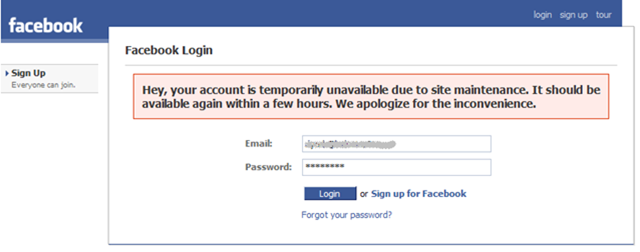
image As did many users this morning, I tried to login to Facebook this morning only to find the message displayed on the right – sorry, we’re down for maintenance.  I’ve been too busy in the last couple of days here at the conference to go onto Facebook, but I’ve seen a number of messages on Twitter that people have been having problems getting into the site over the past couple of days

Given that Facebook wants to be the “social operating system”, the question is – what is their plan for being available?  Are they having scaling issues?    If people come to use Facebook as a communication medium, what plans does Facebook have in place to ensure that it is available when people want to communicate?

Technorati tags:

FriendWheel provides an interesting (and pretty) way of visualizing the connections between your friends

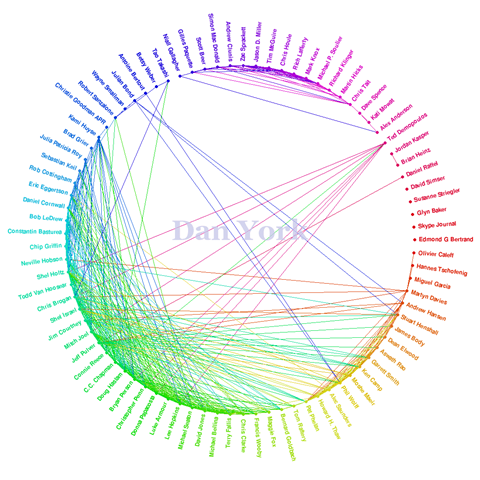
image As I’ve always been fascinated by ways of visualizing data, I naturally had to try out the “FriendWheel” application now available inside of Facebook.  One result, taking all the defaults, is now visible on the right (click for a much larger image).  The “What is this?” link on the page says this:

The circle shows part of a social network. Around the edge of the circle are Dan York’s friends. If two of them are connected by a line, it means that they are friends with each other. Relationships between different groups of friends (eg. “Home friends” and “University/College friends”) can often be seen in the circle. It’s also brightly coloured and looks pretty.

Once you add the app to your Facebook profile, you can then configure it using a range of settings and then generate the wheel image.  It takes a little bit because it has to get information about your friends and their connections in order to generate the information. 

Naturally, I was a bit concerned about the fact that data about all my friends and their connections were going to someone else’s computers, at least for the time required to generate the image, and so did read the privacy policy, which states this:

Friend Wheel will retrieve the names of all your friends and all links between your friends. This data will be shown on the friend wheel image. This image is not publically viewable (but you can show it to whoever you want by sending them the entire URL of the enlarged image).
Your Friend Wheel will be accessible to anyone who knows the pass-code for your wheel. This is shown (as part of the URL) in the “Friend Wheel” box on your profile, so anyone who can see this will be able to see your wheel.
To configure who can see the wheel on your profile, visit the
Applications Settings page (click on “edit settings” next to Friend Wheel and choose from the drop-down box).
You can remove the application at any time. Your Friend Wheel will then be deleted.

However, this doesn’t answer the larger question to me about the fact that the data about all my friends and their connections is at least temporarily residing in “Thomas Fletcher’s” computers while the script is running.  I guess we have to hope he’s not doing anything with the data (or else we don’t use the app).

image In any event, potential privacy concerns aside, the tool is quite interesting.  You can choose to graph only a subset of your friends, graph one of your networks, graph a random assortment of friends, graph mutual friends of one of your friends… and more.  Lots of other tweaks you can make to it.  In the image to the left, I changed the “grouping algorithm” from the default of “FriendGroupster-4000”, which appears to put blocks of your friends together, to just a straight alphabetical grouping.  This, obviously, doesn’t really help you see a whole lot.

I noticed today that the developer has added an “Interactive Flash Map” which lets you play even more with the data:

You can mouseover friends to highlight their links, click and drag to move friends around, zoom in and out by using the buttons in the top left, and pan by clicking and dragging in white space.

All in all an intriguing little app that helps highlight the connections between your various “friends” within Facebook.

UPDATE: I meant to note that where I first saw Friend Wheel being used was in Phil Wolff’s new banner for Skype Journal (described here).

If Facebook is the new "Internet portal", why are you not supposed to do business on it? (aka more on Facebook’s TOS, privacy (or the actual lack thereof), content license, etc.)

Last week I wrote about Facebook’s Terms of Service and the fact that they basically own all the content you upload, but over the weekend legal student and blogger Andres Flusche wrote: “Facebook Isn’t Private, and 7 Other Things You Should Know“.   He nicely summarize the content licensing issue (that was at the heart of my own post on the subject) with this:

In plain English, this means you’re giving up copyright control of your material. If you upload a photo to Facebook, they can sell copies of it without paying you a cent. If you write lengthy notes (or import your blog posts!), Facebook can turn them into a book, sell a million copies, and pay you nothing. This deserves careful consideration!

Indeed it does deserve careful consideration!  For instance, I’m debating whether the additional visibility garnered by importing this blog’s postings into Facebook Notes balances out with the fact that, as Andres notes, Facebook can do whatever they want with them.  For the moment, I’m continuing to import my entries… but I’m debating and may very well stop the import.

Another point he makes is the “personal use only” nature of Facebook.  He quotes the Facebook Terms of Service:

You understand that except for advertising programs offered by us on the Site (e.g., Facebook Flyers, Facebook Marketplace), the Service and the Site are available for your personal, non-commercial use only.

One wonders then, how Facebook aims to be the “social operating system” if it is all to be for your “personal, non-commercial use only“.  What about the large number of “business” users flocking to Facebook?  If I bring in my business contacts is that a personal or commercial use?  What if we exchange Facebook messages about a potential opportunity?

His other points about the ability to change the terms, legal issues, etc. are well worth a read.

Facebook and the giant sucking sound of all your content coming in… and never leaving… forever… (and Facebook can do whatever it wants with it!)

Three vignettes to set the stage for the entry. First, Chris Brogan realizes that Facebook is a walled garden through his Twitter stream:

Facebook messages doesn’t have FORWARD??? WTF??? You can’t be an email product and not have the BASICS. 09:59 AM July 16, 2007
So, when you’re *IN* facebook, using the messaging feature is cool. @Spin and I are having a video conversation and it’s so cool! 10:09 AM July 16, 2007
but I just realized, I can’t DO anything with the last video, that made me laugh and roar. I wanted to remix it. No download. No embed code. 10:10 AM July 16, 2007
Dan York wrote the article I was going to write tomorrow. Just read his: http://tinyurl.com/27jxxw 01:14 PM July 16, 2007
Sick of Facebook not letting out data. Mr. Zuckerberg : TEAR DOWN YOUR WALLS! 12:59 PM July 17, 2007

Second, a friend  and I are having an IM chat:

<name> says: I looked at your blog and noticed also the facebook entries
<name> says: Do you think that it is a cool stuff?
<name> says: I wasn’ t quite sure.
<name> says: Whenever I looked at it I just didn’t see anything where I could have said “That’s really cool”.
Dan York says: Facebook is… well… “interesting”.
Dan York says: What intrigues me the most is that there is now a whole class of (typically younger) people who are basically experiencing “the Internet” through the lens of Facebook.
<name> says: That does not make sense to me.
Dan York says: Basically, they don’t use “the web”, per se, but instead use Facebook and have components of the web brought into them that way.
Dan York says: They are always logged into Facebook.
<name> says: Really?
Dan York says: Instead of email, they use Facebook messages.
<name> says: Why would someone want todo that?
<name> says: That’s quite restrictive.

Third, Jeff Pulver makes the declaration in multiple blog entries, such as this one:

Facebook IS the internet portal of 2007. And it is where you will find me.

Let’s face it… at the end of the day, Facebook is a “portal play”.  If you want to use Facebook as your “lens through which to see the Internet”, it has amazing capabilities and possibilities.  There are an incredible number of applications now being developed.  Facebook now reports having over 30 million active users.  They say their search engine is now among the top 20 on the web.

You would be completely and utterly stupid to not think about a “Facebook strategy”.  With its growth curve and the sheer amount of content flowing into it, I think you ignore it at your own peril. 

To be honest, I like Facebook. I have an account there which, at this point, I am in pretty much daily.  I’ve been using “groups” there to see about building stronger communities.  There is now a “network” of employees at my company.  The “Facebook Platform” is quite intriguing and it’s fascinating to see the apps that people are developing.

But…

The challenge remains that the walls around Facebook are actually open a bit – but only in one direction – inbound!  Through the “Platform”, you can bring into Facebook all sorts of content.  On my Facebook profile page, you can find such things as:

  • Updates I’ve made through Twitter
  • Blog entries that have been automatically pulled in from an RSS feed
  • My Skype status
  • My latest del.icio.us links
  • My latest Pownce post
  • The status of my SIP phone connected to VoIPUser.org

And much, much, MUCH more… basically at this point I can pull pretty much anything in and display it on my Facebook profile page – and also have it in my “Newsfeed” that I can see and monitor on my home page.
image Ah, but wait, if you aren’t a Facebook user, you couldn’t see it, could you?  No, you have to login first in order to see any of that content.  Only once inside the Facebook walls can you see it all.  Naturally you could go to any of those services individually and see the information from a standard web browser, but if you want it all aggregated and displayed along with other content, you have to login and become part of the portal.

On one level, I definitely appreciate what Facebook is doing.  They are succeeding as a portal where things like Yahoo!’s personalized pages or Google’s iGoogle or <pick your portal play> have not… in part because of the API that let’s so many users in, in part because of the “social networking” elements of the site, in part because of the “News Feed” that let’s you see what your friends are doing and contributes to the viral flow of information.  There’s a really nice aggregation of various social services going on.

But what if I want to make content inside of Facebook visible outside?  As Chris said:

but I just realized, I can’t DO anything with the last video, that made me laugh and roar. I wanted to remix it. No download. No embed code.

It can’t be shared with anyone who isn’t inside of Facebook.  It can’t be posted to YouTube or made available as a blog entry.  Outside of widgets to show your status and the one single RSS feed that seems to be available for your friends’ status messages, everything else is inside of Facebook.  If someone sends you a great message, you can’t forward that outside of Facebook.  You can’t share content you create with those on the outside.

It’s there… inside Facebook.  In fact, if you take a look at Facebook’s Terms of Service, basically anything you create inside of Facebook really belongs to them (down under “User Content Posted on the Site”, second paragraph):

When you post User Content to the Site, you authorize and direct us to make such copies thereof as we deem necessary in order to facilitate the posting and storage of the User Content on the Site. By posting User Content to any part of the Site, you automatically grant, and you represent and warrant that you have the right to grant, to the Company an irrevocable, perpetual, non-exclusive, transferable, fully paid, worldwide license (with the right to sublicense) to use, copy, publicly perform, publicly display, reformat, translate, excerpt (in whole or in part) and distribute such User Content for any purpose on or in connection with the Site or the promotion thereof, to prepare derivative works of, or incorporate into other works, such User Content, and to grant and authorize sublicenses of the foregoing. You may remove your User Content from the Site at any time. If you choose to remove your User Content, the license granted above will automatically expire, however you acknowledge that the Company may retain archived copies of your User Content.

Note especially the part in bold.  All your content belongs to us. Irrevocably. Perpetually.  “To use, copy, publicly perform, publicly display, reformat, translate, excerpt (in whole or in part) and distribute… to prepare derivative works of, or incorporate into other works…”  Even after leave, they will have an archive of your content.  Forever.

Translation:  All your content belongs to us.

Now consider this… through the various applications, I’m bringing into Facebook my entries from this blog, my Twitter posts (tweets), my del.icio.us bookmarks.  Potentially videos and pictures.

It would certainly appear from the ToS that I’m giving Facebook a license to do whatever it wants with all of that content.  Forever.

Interesting.

If you are a Facebook user, are you aware that you are giving Facebook that right to all of whatever content you bring in?  (Do you care?  Perhaps not.)

And do you care that in order to really use Facebook to its fullest, everyone with which you communicate really needs to be a Facebook user?

Don’t get me wrong.  I have no intention of not using Facebook.  With its incredible growth in terms of users and apps, I do believe you ignore it at your peril.  It may very well be “THE Internet portal of 2007”.

But let’s realize that that is what it is… a portal… a “lens” through which you can see Internet content and collaborate with friends.  Granted, it’s a portal with a really nice platform for bringing in content from the rest of the Internet into its own private garden. But the walls around the garden are quite high… and no one can really play inside that garden unless, they, too, come inside the walls.  (And bring their content with them…)


UPDATE: There is some synchronicity happening on the web today… shortly after posting this article, I noticed two other posts today related to the same theme:

Does your employer have rights to your Facebook profile or LinkedIn contacts list?

Does your employer have the right to request access to your Facebook profile or LinkedIn contacts list if you leave the company?  That’s essentially the question asked in yesterday’s Register article: “Your boss could own your Facebook profile.” The article is primarily about a legal case where someone (Junior Isles) was leaving a publisher (PennWell) to go set up a rival firm and was insistent on taking his contact list with him.  He had brought some of that list with him to PennWell, but had then added to that list while there. The key paragraphs to me are:

The Court ruled that the list belonged to PennWell. It said that if he had maintained a separate list of contacts for personal purposes and added selectively to it, he could have kept that. It also said that he could have taken his personal contacts and any that he brought to the firm in the first place with him.

Because Isles had tried to take the whole list, PennWell was allowed to keep the database of contacts and was also granted an injunction preventing Isles from using the database. The company did allow Isles to keep and use the contacts he had brought to the firm, though.

The ruling confirmed the right of an employer to treat as its own property the creations of its employees if they were made in the course of business. That includes digital creations, even if some of that creation is for personal purposes.

There is no direct connection here to Facebook, but the article makes the connection to social networking services and quotes IP lawyer Catrin Turner of Pinsent Masons:

“If [the employer] can argue that you have created something and it’s in the course of your employment, it’s irrelevant where it’s stored because the law doesn’t look at where it’s stored, the law looks at the circumstances in which it was created,” she said. “If you create a contact list or any sort of document during working hours using your work PC that relates in some way to your job or is of value to your employer they would have a very strong argument that that belongs to them.”

And then later this:

“The basic law is that if you create copyright material, something you write or type into a computer, you take photographs, you do cartoons, you potentially create film, if that is created in the course of your employment then the assumption is that that belongs to your employer, so that doesn’t have to be written down by your employer,” she said.

All in all it’s an interesting question that will no doubt be sorted out in legal cases over the next few years.  Once upon a time (and still, in many/most cases), we built contact lists for our employer inside the firewall… in CRM systems, databases, spreadsheets, etc.  While we still do that, we also build those contact lists externally through Facebook, LinkedIn and the many other social networking sites – as well as our IM contact lists.  Where does the dividing line exist between what is your employer’s intellectual property and what is yours?  (Especially given that most corporate folks are probably accessing all those sites and services using their corporate PC or laptop!)

It shall be an interesting time to see how this all gets sorted out as the line between work and personal time/space gets increasingly blurred or even erased.  There’s probably going to be a whole lot of job security in being a lawyer dealing with such matters…

(Tip of the hat to Denise Howell’s Lawgarithms ZDNet blog, where I saw this link.)