Category Archives: Facebook

Sorting "network" members – another way that Facebook needs to grow beyond the college crowd!

image Today I went into one of my “Networks” in Facebook and was interested to see all the members (it was for my employer, and there are now 71 members in the network) and found yet more ways that Facebook needs to “grow up” outside of the college/university crowd.

First annoyance was that it just shows me some number of random network members.  If I click “Show More”, I get some another batch of random members (seems to vary between 3 and 10 random members it shows).  However, if I change the “Sort Method” to “Alphabetical” I will then be able to browse through pages of, apparently, all the members.  I would really like the Alphabetical sort to be the default (realizing that some networks will be too big).

But the second annoyance was the sort options.  If you click on the image on the right you will get a larger version and see what I mean.

Here are the options for how to sort:

  • Sex (M/F)
  • Age
  • Relationship Status (and this is the one open by default)
  • Interested In (answers being “Men” or “Women”)
  • Looking For (essentially what type of relationship you want)
  • Political Views
  • Other Criteria (where the options are “Concentration”, “College Year”, “Religious Views”)

Now, keep in mind that this is for a work network!  Why do I really care about any of this for my co-workers?  Outside of Sex which may help me sort through it better?  I guess if I want to have a workplace relationship, but, well, sorry… I’m happily married and have no interest in any of that.

How about things instead like?

  • Currently employed with company (the network seems to have some former employees in it)
  • Job title/category
  • Interest
  • Skills  (things like programming languages, specialties)
  • Languages (of the speaking variety… say I want to find someone who can speak Italian)

I could go on… but you get the idea.  Those are the type of things I want to search for in the “work” context versus the “personal” context.  For Facebook to really gain traction within businesses, I think it will need to “grow up” a bit beyond the college/dating scene and add these type of search/sort capabilities.

What do you think?  Is the current kind of sorting useful to you in a work context?  Or do you want something more like what I outlined here?

Technorati tags:

SocialNetworkDevCamp – an unconference for developers interested in mashups and APIs in social media tools…

imageWhat are you doing on September 8th and 9th, 2007?  If  you are in the San Francisco Bay area (or can get there), and more precisely Richmond, California (a bit north of Oakland and Berkeley), it appears that there will now be an “unconference” called “SocialNetworkDevCamp” with the purpose:

SocialNetworkDevCamp will focus on API and Widget development from Facebook, Twitter, Pownce, Linked In and others. The camp will also start the process of identifying open APIs and data structures which would facilitate the creation of open standards for social networking.

Very cool to see…. and hopefully it will stimulate a good bit of discussion and action around the potential mashups that can occur between all these various services.  “Open standards for social networking” would also be very good to see!

If are interested in attending, just edit the wiki page and add yourself to the list of participants (or volunteers).

(Tip of the hat to Julian Bond for raising this issue in a Skype groupchat focused on mashups.)

FaceReviews.com – A sure sign of the success of Facebook Platform when there is a site out to review Facebook apps…

image You have to know that the “Facebook Platform” is being successful when there turns out to be an entire web site dedicated to reviews of Facebook applications!  Yes, indeed, courtesy of the previously mentioned Reuters article, I learned today about FaceReviews.com run by a gent named Rodney Rumford.  (Yes, okay, so I missed it when it appeared on Digg back in mid-June. Hey, I was on vacation!) In looking through the site, I learned of a number of apps I hadn’t yet seen (like this one remarkably from LinkedIn or this one from c|net).  I do like the way he is providing a “rating” of apps – if you are going to do reviews, a rating is a good thing to have in my opinion.

In any event, it’s good to see a site like this and I’ll be adding it to the list of “social media apps” sites I watch.

Reuters reports on Facebook and its growth, app platform (and the fact that its walled garden is a plus)

image Reuters today came out with a lengthy article, “PluggedIn: Facebook lets friends share private view of Web“, that will undoubtedly only continue to fan the flames of Facebook growth.  That growth, in fact, was apparently 1 million new Facebook users in the last week and 5 million in the last 6 weeks.  All in all, not a bad growth curve!  The article starts with the requisite quotes that people need a “Facebook strategy” and other such statements typical of recent Facebook articles.  It also weighs in on the privacy issue:

“Facebook is inherently not open the way the Web is open. Users share all kinds of information on the site they would never share on the Web,” (Facebook CTO Adam) D’Angelo, 22, says. “We get users to divulge more information because we protect users’ privacy.”

Let’s just pause there and take a look at that first sentence again:

Facebook is inherently not open the way the Web is open.

Therein lies my fundamental problem.  Don’t get me wrong: I am a Facebook user.  I am logged into the site pretty much every day.  I’m also a huge privacy advocate who wants control over what information I expose to whom.  So on one level, I do applaud what they are doing.  I’m also a huge fan of open APIs and platforms… so I like what they’ve been doing with their “Platform”.  But I still go back to my feeling that, as I wrote about previously, we’re returning into a world of walled gardens.  To read messages, I have to be logged in to Facebook.  To use the apps, I have to be logged into Facebook.  Facebook has to really be my “portal” to the Internet.  Now, obviously that is good for Facebook… but it worries me to have one site become the lens through which so many people view the Internet.  (Obviously, similar statements though could be said about MySpace or even iGoogle or Yahoo…)

In any event, the Reuters article will no doubt expose even more people to Facebook and generate more interest.  I did enjoy page 3 where they talked about the sudden success application developers have had.  It will indeed be interesting to see where Facebook evolves.

Pownce, Twitter, Jaiku, Facebook… and the perpetual quest for the next bright, shiny thing…

Does this sound familiar?  There is suddenly a site about which absolutely “everyone” you know is suddenly talking.  Suddenly, you have just got to join that site – but of course you must have an invitation and they are hard to get.  You are, though, being asked by all sorts of people you know… who keep telling you how great it is and how this new site will completely revolutionize the Internet and fundamentally alter the way in which we communicate.  Once you give in and join you suddenly find yourself deluged in requests to be added as a “friend” by some people you know and then also by many others you have no clue who they are.  It’s the “new” Internet.  It’s the end of everything old and the start of everything new.  It’s the best invention since sliced bread.  You just gotta see it!

What site am I talking about?

Hmmm… how about Orkut in 2004?

That was certainly the view in those days…. everyone was madly adding Orkut friends, filling out their Orkut profiles… wildly creating “communities” within Orkut and finding new communities to join.  Just like today’s Facebook Groups, you could learn a great amount about someone by the communities they joined.  Private messages were flying back and forth and it was just the place to be, even if many were uncomfortable with the focus of the site on dating.

But then somewhere along the way a good number of folks, myself included, were off to chase the next bright, shiny thing and we stopped checking in to Orkut all that often.  Spam increased within the site, the Brazilians took over … and the rest is history.  There are obviously still a lot of folks using the site, and occasionally I get a message in email that reminds me I need to go visit (usually to remove the “scraps” that spammers leave).

The pattern repeats and repeats and repeats and repeats….

After Orkut, the place to be was LinkedIn… Friendster… Xing… LiveJournal… MySpace… today’s darling seems to be Facebook.

Over the past months “presence services” have seemed to be the rage.  First it was Twitter… then there was a “great migration” over to Jaiku…. then some folks started thinking Facebook status updates were the best… meanwhile all the IM addicts were wondering how these new services were all that different from the IM “advisory” or “mood” messages people had been changing for some time.  (And fundamentally they really aren’t different, except that you can get them via RSS or on a web page and thus have a history.)

image Now, today, some of the Twitter-addicted seem to be convinced that Pownce is the next bright, shiny thing and it will solve all the problems with Twitter and bring us to communication nirvana.  Naturally, being a professional chaser of bright, shiny things, I had to sign up for Pownce.  First impression is that it’s a lot like Twitter with better replies and a way to have both public posts and also ones only visible to your friends.  (Which, of course, I’ve had from a blogging point of view with my LiveJournal account since back in 2004.) Okay, and it has its own desktop software.

Of course, to use it means that I have to rebuild a list of “friends” similar to the lists I already have in all the aforementioned presence, IM and social networking services.  I will, naturally, because there is something in my mental makeup that compels me to try out new services like this.

Meanwhile, of course, someone else is telling me that Hictu.com is really the place to be… if I’ll just go there and sign up, the mist will be lifted from my eyes and everything will be amazingly clear.   Hmmmmm…..

Ken Camp starts a new series of posts on Jaiku and the new client for Nokia S60 phones

(Originally posted over on my Disruptive Telephony blog… but I thought it made sense here as well.)

imageI have not really written about Jaiku here at all… I have been meaning to explore it a bit more, but just haven’t had the time.  What limited time I have had lately has been more focused on Twitter, Facebook, Skype and the evolving mashups of all of those.

But Ken Camp has been writing and advocating Jaiku, and is starting a series of posts with his one today: “Unveiling the new Jaiku Client for Nokia – Part 1”  Ken is going to talk more about the new client for Nokia S60 phones.  But this part of his first post is perhaps more revealing:

First, if you aren’t a Jaiku user today, you need to understand that Jaiku is what I call a lifestream aggregator. When you build your profile, you have complete control over what you wish to share of your lifestream of information. For many, that’s simply their Jaikus. Using this approach, a used can share brief snippets of information – current status, pose a question, leave a thought – for others to see.

Digging more deeply into Jaiku, we find you can also import RSS feeds of all flavors into your lifestream. For me, this means if you read my lifestream, you see blog posts from three different blogs, Flickr photos, blip.tv video posts, even Twitter posts. I’ll explain more about why I think this approach is revolutionary and exciting in a post tomorrow or Friday. It’s taken me a while as a Jaiku user to develop an appreciation for just why this is apprach to aggregation is really important. I think it’s positively revolutionary from a social networking perspective.

I agree with Ken that this type of “lifestream aggregation” represents a direction in which social networking is evolving.  The challenge, I think, really comes back to where you do that aggregation.  Jaiku would like to be your aggregator.  So would Twitter (which can bring in RSS feeds through sites like Twitterfeed.com).  And so indeed would Facebook which now includes an RSS application as part of its platform.

So which do you choose?

All are, to varying degrees, walled gardens of some sort.  Ken can’t follow my status updates because I primarily use Twitter.  Alec Saunders does most all his updates within Facebook.   We do need to have some kind of common aggregator.   We need to tear down the walls so that we don’t wind up in isolated islands of communication.

But in the meantime, if you want to read about how pretty and nice it is inside of the walled garden of Jaiku, head on over to Ken’s post to read more.  This is Part 1, with the others to follow soon thereafter, I would expect.

On the need to aggregate status updates, a.k.a. why do I have to update my status and check friends’ status in so many #$@%@# places?

Over the weekend, Ross Mayfield posted “Status Contests and Attention Aggregators” which speaks to an issue I myself faced this morning.  As I have been talking about my impending trip to Stockholm for VON Europe/Podcamp Europe for the past while, I felt an obligation to tell folks that I was not going to be there.  So what did I feel I needed to do:

  • post a note at my blog Disruptive Telephony
  • post a note on my blog Blue Box: The VoIP Security Podcast (assuring people that tonight’s dinner was still on)
  • post a note on my blog Disruptive Conversations
  • post a Twitter update
  • update my Facebook status
  • change my Skype IM mood message (for a little while, anyway)
  • send out email to various folks with whom I had discussed meeting while there

This actually was a good bit of work.  Now, granted, part of it was self-imposed by virtue of my splitting my blogging out from my single blog (curiously, the only one of my major blogs that I did not feel compelled to update).  I also did not update my other IM services because for most of the people with whom I was corresponding, Skype seems to be their IM client these days.  But let’s just collapse this list and also drop out the direct email which is just kind of an obvious item – so here were my updates:

  • blogs
  • Twitter
  • Facebook status
  • IM mood/advisory messages

Still a good number of places to update[1].  And still a pain in the neck that takes a bit of time… perhaps not a lot, but still, a bit of time.  What I really want is a tool that lets me update my status once and then have it automagically posted across all my various “status services” and blogs.  As Ross posts:

Maybe they can work out a way to let you write your status once, publish everywhere, and remove dupes when aggregating.

Or to invert it, I need some way for all of those sites to pull my status from a central location.  Perhaps it’s like the widget displayed on this page that pulls my info from my Facebook status… but, of course, that widget isn’t integrated into my RSS feed for this blog so those who read by RSS will have no view of that widget and my current status in Facebook.

The challenge goes back in part to my previous discussion of the “walled gardens” of social networking.  Part of why I feel compelled to update my status in different places is because there are different “communities of interest” with whom I communicate in those different areas.  There are some who only read one of my blogs.  There are some who only read my Twitter stream.  There are some who live online inside of Facebook… while others really only pay attention to IM.

There are different audiences within different walled gardens.

I am the same way.  There are some people I only follow in Twitter.  Others only in Facebook.  For a good number, I see their Facebook updates, Twitter updates and their blog updates.  But they don’t know that.  If they want to post a message that they want all of their various friends and followers to see, what do they have to do?

Post everywhere, naturally.

Breaching those walls – or at least running communication conduits through the walls – will become increasingly important as people continue to understand the utility of these various different “status services”.  I agree with Ross Mayfield that new forms of status aggregators will need to evolved.  The walls must be torn down – or at least eased a bit – because the current situation can’t really last long, especially if these services are to move up the curve into mass adoption.  (Either that, or one or two of the biggest sites will win out as the place that people use for status updates.)

[1] And yes, I could throw my MySpace page in there, too, but I don’t really use it all that much and so have not attracted people who follow my updates there.

How to be more productive with Facebook? Try the Facebook toolbar for Firefox!

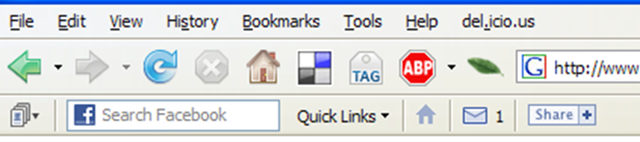
image As part of my continued experimentation with Facebook, I recently installed the Facebook Toolbar for Firefox and have to say that I’m quite impressed.  Now, this toolbar isn’t new… it was released back in November 2006, but I just hadn’t tried it out yet.

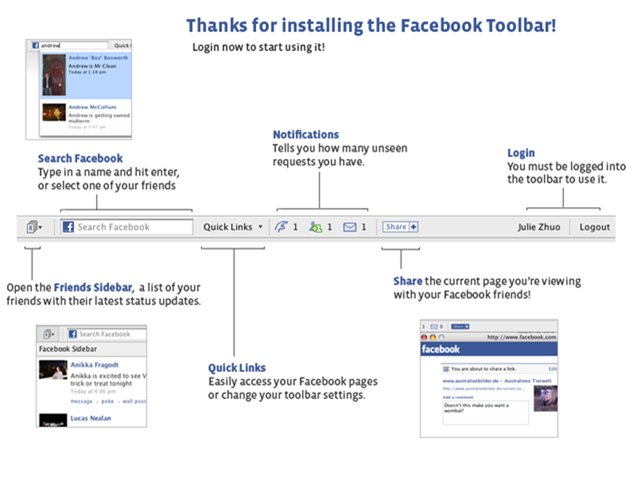
image As shown in the image to the right (from Facebook’s web site), the toolbar offers a good number of features.  I haven’t really used the “search Facebook” feature, but I definitely do like the notifications that appear telling you how many messages or friend requests you have.  With a single click, you can jump directly to that part of your inbox.  Even more useful to me is the “house” icon that takes you directly to your Facebook home page.  Great way to jump there when you want to.  The “Quick Links” feature similarly gets you to other parts of Facebook.

I also like the “Share” button that lets you easily post a link with commentary to your internal Notes page inside of Facebook.  In a way, it’s similar to the del.icio.us add-on to Firefox that I use… a pop-up appears, you enter the commentary and press the submit button.  Of course, this toolbar only posts inside the walled garden of Facebook… but it is a nice quick way to get info posted there.

imagePerhaps one of the greatest things I like about the toolbar is the fact that after you install it you get pop-up “toast” notifications when friends update their status message, send you messages, add Notes, etc.  So now I get toast pop-ups for Facebook along with those pop-ups for various IM notifications.  I have to say it’s rather nice… but then again, I don’t have a zillion “friends” in Facebook so that I’m always seeing status updates.  If I did, this could be a bit annoying.  For now, though, while I continue my experimentation, I do find it quite useful.

All in all, the Facebook Toolbar has already made my personal use of Facebook more productive.  If you are looking for a way to enhance your use of Facebook, do check it out.

Facebook… as an "application platform"? (and a collection of links on the topic)

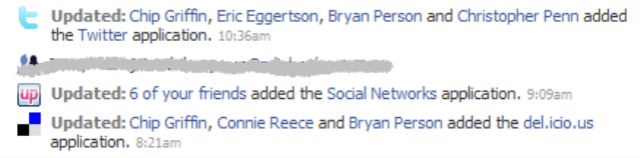
For those of us using (or experimenting with) Facebook, the information shown in the image to the right (click for a larger image[1]) is become rather routine.  Yes, indeed:

Facebook users are going crazy adding “applications” to their profiles!

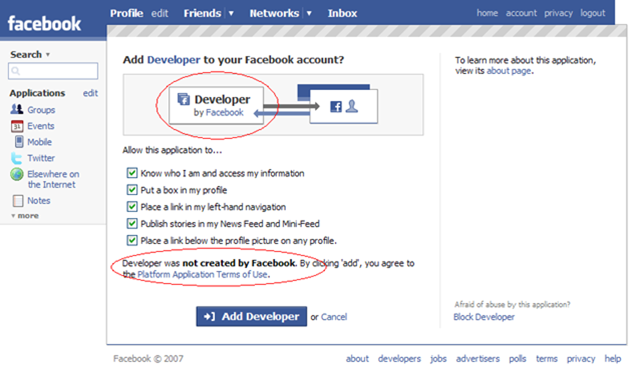
Applications?  Huh?  In Facebook? It’s “just a social networking site”, right?  So what’s with the apps?

Well, it’s pretty clear that Facebook has much grander aspirations (see all the links below). Although it was only mentioned briefly in a post to the Facebook blog last Friday, the “Facebook Platform” is now out with full documentation of the APIs and a range of applications already out there (you can also take the “Platform tour“).  While people have been building apps for Facebook for quite some time, the big launch was last Friday and this weekend. (This CNN/Fortune story, “Facebook’s plan to hook up the world” is probably a good place to start.)

Primarily, the applications seem to allow you to either:

  1. add content to your “Profile” page inside of Facebook (as I have done with “Elsewhere on the Internet“, an app that lets you easily add external links to your profile); or
  2. interact with some external service (as I have done with the Twitter app, which essentially embeds your Twitter home page inside of Facebook and also puts your latest entry on your Facebook profile)

This alone makes it quite interesting as a way to integrate and distribute applications, but the more intriguing aspect of the “Platform” is that applications have access to the “News Feed” that appears on your own Facebook home page and appears in a similar fashion to your Facebook “friends”.  There’s two elements here of interest:

  1. Viral distribution – As I note in the image above, whenever a friend installs a new application, you learn about it from your News Feed and can easily click the link to see what the app is.  I’ve done this myself already numerous times, and I’ve also noticed friends installing an app that I installed in the day or so after I’ve done so (perhaps because they saw the fact that I installed it in their News Feed).  This provides a fantastic “word-of-mouth” type of distribution of apps and introduces you to apps you might not have heard of. [2]
  2. Direct access to the News Feed – Whenever someone posts from the Twitter app inside of Facebook, I see it in my News Feed.  Thus, the News Feed becomes the merger of all the other Facebook items plus the items from the Facebook application.  Now, there are some limits as to the number of times an app can access your feed (so that you don’t get flooded), but it’s definitely an interesting development.

I think that I will no doubt be writing a great amount more about this Facebook Platform over the coming while.  I still have a great concern about the “walled garden” aspect of Facebook and I agree with Jeff Jarvis about the need for the platform to ideally be far more open.  But this is certainly an interesting step in the evolution of the site – and it will be quite fascinating to see what emerges.

While I will write more, in the meantime, let me point to some of the articles in the great mass of coverage (or even more here) that I found more interesting (Note, Facebook CEO Mark Zuckerberg announced all this at Facebook’s “F8” conference last week and some coverage is calling the Facebook platform “F8”):

[1] And yes, that grey line is me using the “spraypaint” in Windows Pain to obscure an entry that is not relevant!

[2] For instance, I just learned from my News Feed that one of my friends in the hockey-mad world of Ottawa, Canada, just added the “Go Sens Go!” application – although to understand what that is, you would need to understand that here at the end of May when the rest of North America is enjoying the warmth of Spring and Summer, those folks up in Ottawa are still obsessing about a bunch of men sliding around on ice!