Category Archives: Facebook

Apple’s Ping to Connect with Facebook? (iTunes 10 screenshot…)

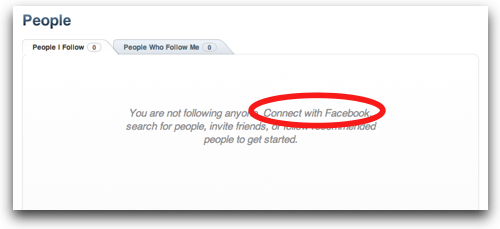
With the announcement of Apple’s Ping “social network for music” yesterday, I naturally had to download iTunes 10 and check it out.  Outside of finding that so far pretty much zero of the older artists I follow are on Ping, I was intrigued by this screen:

iTunes10-facebook.jpgOthers have noticed this, of course, and a Cult of Mac article about it has comments from folks who were able to link to Facebook to see if their FB friends are on Ping.

It’s just curious, given the lack of Facebook mention in Steve Jobs’ keynote yesterday and then Kara Swisher’s All Things D article:  ‘Steve Jobs on Why Facebook Is Not Part of Apple’s New Ping Music Social Network: “Onerous Terms”‘ (And I’m somehow not surprised that Facebook had “onerous terms”…)

It would be logical if they did allow that connection… it’s annoying to enter a new social network and have to, yet again, go through the process of connecting to people on the network.  This is why data portability matters, as I’ve written about over the years, and why we need projects like the DataPortability Project to succeed.  Upon entering a new network like Ping, I want to connect with my “tribe” very simply and easily…

Meanwhile, given that the bands I like, such as the Scorpions, AC/DC, Rush, etc., (or even Nickelback!) all don’t seem to be on Ping yet, I’ll just look at my blank page and wait for a few friends to show up on the service… perhaps I can find some newer music 😉


If you found this post interesting or useful, please consider either subscribing to the RSS feed or following me on Twitter or subscribing to my email newsletter.


Does Facebook Change a 25th High School Reunion?

classof85reunion.jpgWhat if you went to a “reunion” already knowing a great bit about the people you are reconnecting with? Would it allow you dispense with all the initial “small talk” and move on to having deeper conversations? Would it make it better? worse? awkward? great?

I’ll find out myself on Saturday evening. You see, I’m traveling back down to southern Connecticut where I grew up to attend my 25th high school reunion – and Facebook has added a fascinating dimension to the gathering.

RE-CONNECTING

A year or two back (it may even be more now), some people from my hometown created a Facebook Group for people who “grew up in the 70s and 80s” in our town. I joined that group and through that reconnected with a good number of folks that I literally hadn’t communicated with in most of 2 decades. (Hmm… using “decades” makes me feel old!) Over time that communication has led to multiple phone calls, great email/message exchanges and even a couple of face-to-face meetings in different parts of the world.

Then maybe a year or so ago as the excellent organizer started planning this Saturday’s reunion event, she set up a Facebook event, sent out Facebook messages and otherwise integrated Facebook into the outreach she was doing to find and alert class members. There were something like 300 people in my high school graduating class and obviously over 25 years we’ve drifted around the world.

The result has been that I’ve reconnected on Facebook with a good number of people who I can truly call “friends”. I grew up from birth in the same town as did many of them… and we shared the same classes, teachers and community activities in our town of then around 25,000 people. We liked each other and hated each other and liked each other again… and all the other dynamics that happen in longstanding communities.

THE EFFECT

The fascinating part, to me, about the reconnection on Facebook is that – for the people on Facebook – I now go into the reunion already knowing many of the small details that you typically start out with… “what have you been doing for the past 25 years?“… is already partly or mostly answered. In many cases, I already know:

  • where they are living now
  • what people look like now (though not all have posted recent photos 😉
  • who is married, divorced, remarried, single, etc.
  • who has kids and who doesn’t
  • if they have kids, how old the kids are, what they look like, what activities they are into
  • what people do for a living now, and potentially what kind of career they have had
  • what special highlights people have experienced (ex. books written, awards received…)
  • what people like to do in their spare time
  • who likes to place games on Facebook
  • who has an active social life
  • what music they like
  • in some cases, their political or religious views

The interesting part is that this knowledge has come to me NOT from me going out and reading their individual profiles or anything focused like that… but rather just from the “ambient intimacy” of having their updates appear in my Facebook NewsFeed over the past year or two.

They, of course, also probably know way more than they ever needed or wanted to know about me, given my prolific online content creation, be it writing, video, audio, etc.

THE IMPACT?

Will this make the reunion better? worse? the same? I don’t know… in some cases I know we’ll be able to start out at a deeper level. In at least one case, I know now to avoid political discussions. 🙂 It will be interesting to see.

Another note is that a good number of people are not on Facebook and so, with them, the conversation does start back at that question: “so, what have you been doing for the past 25 years?” Does that create a disparity between the “strongly connected” set of people and those who are more weakly connected?

All interesting points to ponder as we consider the continued blurring of our lives and how Facebook and other online tools/services continue to change how we connect and communicate.

I’m pretty sure, though, that I won’t be pondering any of that Saturday night… I’m just looking forward to an evening getting together with some old friends… 🙂

What about you? Have you attended a reunion for a high school or college (or other group) after connecting on Facebook? How did it change (or not) the event for you?


If you found this post interesting or useful, please consider either subscribing to the RSS feed or following me on Twitter or subscribing to my email newsletter.


Diaspora (Facebook alternative) provides a progress report and video – “One Month In”

diaspora.jpgAs I wrote about before (and also here), I think the Diaspora project is a great idea and regardless of whether or not the guys truly establish a open, distributed Facebook alternative, the reality is that we’re going to get some darn good research done into how open, distributed systems can be created.

They said they would keep us updated, and true to their word they now have a blog post out: “One Month In

For starters, I was not aware that they had taken up residence at Pivotal Labs… which I view as a great move for all involved.

The post gives a view of what they are working on, lays out their plans for the rest of the summer and provides some screenshoots of a working Diaspora implementation.

They also include this video that shows messages propagating from one Diaspora node to six other ones. It’s not necessarily super compelling video… but it gives a glimpse into working code. And, as they note, this is communication happening without any browser refreshes and without an XMPP server in the background:

Diaspora Message Propagation (pre-alpha!) from daniel grippi on Vimeo.

All in all it’s cool stuff and I’ll continue to be interested to see what they come up with over the course of the summer!


If you found this post interesting or useful, please consider either subscribing to the RSS feed or following me on Twitter or subscribing to my email newsletter.


The final day of Diaspora’s funding drive – will they hit $200,000?

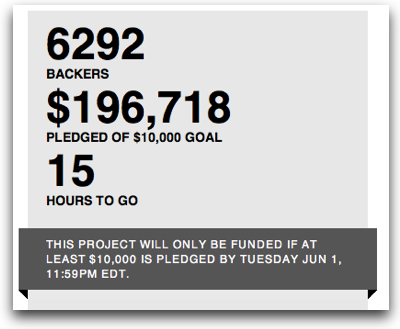
diaspora-june1.jpgToday, June 1, is the final day of Diaspora’s funding drive over on Kickstarter. I love the exquisite irony of the graphic I’ve included on the right side of this post… “This product will only be funded if at least $10,000 is pledged by Tuesday Jun 1, 11:59pm EDT.” …. given that the four guys are closing in on $200K in pledges!

As I wrote about before, the promise of Diaspora is an exciting one for advocates of the “open Internet”. There are many challenges that they face in building a distributed, decentralized social network. There are some aspects of privacy and security that can be easier in a centralized model… but for our own long-term future, it’s great to have some folks out there looking at this issue.

I wish the Diaspora team all the best with their work and will certainly be watching and looking at how I can help. Already, their concepts and ideas have increased the discussion about what we want the “social networking” part of the Internet to look like. They may not succeed… but if not they will certainly help us all in their trying. And in the best case, we’ll have a new service to use that will let us have a bit more control.

Will they hit $200,000 in pledges today? 14 hours left… it doesn’t matter, really… they’ve already received way more than they ever expected!

P.S. And yes, in full disclosure I should state that I am one of those 6000+ backers.


If you found this post interesting or useful, please consider either subscribing to the RSS feed or following me on Twitter or subscribing to my email newsletter.


Will Diaspora give us an “open Facebook”?

diasporateam.jpgTiming is everything.

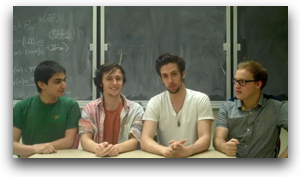
Back on April 24th, four NYU students (pictured: Raphael, Ilya, Daniel and Maxwell), set themselves up on a site called Kickstarter with the goal of raising $10,000 so that they could devote themselves to working full-time through the summer on their idea for Diaspora, “the privacy aware, personally controlled, do-it-all distributed open source social network”. Two of them were graduating, the other two had potential internships… but all they really wanted to do was code.

Three days later they had passed $2500 and were going to start some PR and outreach to relevant blogs.

What they couldn’t have necessarily known was that Facebook would choose this time to anger and alienate so many people with their privacy changes…


TAPPING INTO RAGE

Their one little idea for a project happened to hit the tech world’s radar at just the right time… and landed them with write-ups in tech sites like ReadWriteWeb: Diaspora Project: Building the Anti-Facebook. Business insider discussed “Here’s The Privacy Line That Facebook Just Crossed…” and talked about challenges that Diaspora would have. Many other sites mentioned the project and developers tweeted about it.

Then came more mainstream coverage… the Chronicle of Higher Education… then a Huffington Post article… then a New York Times article, both online and in print: Four Nerds and a Cry to Arms Against Facebook… and then even more of the tech media world went crazy… a sampling:

And many, many, many, many more…
diaspora funding-1.jpgTech superstar Leo Laporte deleted his Facebook account on his This Week in Google podcast and promoted Diaspora on the show – and went on to donate $100 to the project. Twitter was filled with comments and links about Diaspora… Very ironically, multiple Facebook pages are up – one by a fan and one by the team… the buzz was all over the tech space…

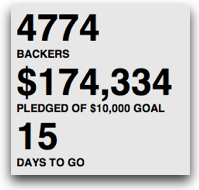
The end result is that the four guys FAR exceeded their goal… as of this morning they had 4774 backers pledging $174,334! The amount will undoubtedly be more by the time you read this article.

The team has been admittedly overwhelmed and written about how their “situation has changed a little“.

You think?


HOW DOES IT WORK?

Well… given that it’s just an idea that the guys are planning to work on, we don’t exactly know yet… but the ideas they describe are that of a “distributed, decentralized social network” that is much more in line with the “open internet” architecture. ReadWriteWeb had a nice explanation:

So what is Diaspora anyway? Instead of being a singular portal like Facebook, Diaspora is a distributed network where separate computers connect to each other directly, without going through a central server of some sort.

Once set up, the network could aggregate your information – including your Facebook profile, if you wanted. It could also import things like tweets, RSS feeds, photos, etc., similar to how the social aggregator FriendFeed does. A planned plugin framework could extend these possibilities even further.

Your computer, called a “seed” in the Diaspora setup, could even integrate the connected services in new ways. For example, a photo uploaded to Flickr could automatically be turned into a Twitter post using the caption and link.

When you “friend” another user, you’re actually “friending” that seed, technically speaking. There’s not a centralized server managing those friend connections as there is with Facebook – it’s just two computers talking to each other. Friends can then share their information, content, media and anything else with each other, privately using GPG encryption.

It’s about eliminating Single Points of Failure (SPOFs)… it’s about putting you in control.

Just as you can choose to operate your own email server or your own web server… or you can choose to use someone’s hosted email or web server… the idea would be that you could run your own “social network” server – or use someone else’s hosted social network.

It’s not necessarily a new idea… it’s what the great folks at Status.Net are trying to do with an open source micro-blogging platform (I wrote earlier about why it matters) so that we can have a “distributed, decentralized Twitter”… and then with the follow-on “OStatus” effort (which the Diaspora guys reference in their latest post)…

The move toward more open communication is going on in other areas, too… it’s what has been going on in the world of XMPP for years to bring about distributed, decentralized instant messaging (IM)… it’s what the federation aspect of Google Wave could potentially bring us…


THE DIRECTORY CHALLENGE

In my mind, a key challenge the Diaspora team will need to address is:

How do I find someone in the Diaspora network?

In the centralized world of Facebook, I can do a search and with the right search terms easily find and get connected to some long-lost friend. Likewise, I can search in Twitter… or for another example, in Skype. All of these services have a centralized database.

Simple. Easy.

Contrast that to the distributed, decentralized world of the Web… or email… or Jabber/XMPP IM… you have to either know someone’s URL or address… or you have to look it up in a search engine like Google.

It’s not as easy as with a centralized service.

I’ve admittedly sent someone a message on Facebook purely because I didn’t know their “best” email address and didn’t have time to look it up anywhere. I knew that Facebook would provide that linkage – and I was already connected.

Somehow the Diaspora team needs to solve the directory challenge… not sure how, but I wish them the best with it and hope they do.


WILL DIASPORA SUCCEED?

Good question… First it sounds like the team needs to grapple with the overwhelming interest and sort out the best way forward.

Second, their going to have to grapple with the enormous expectations now being placed on them!

Third, we all who are watching are going to have to realize and understand that any project like this doesn’t just appear overnight… that the first iterations will probably need some work… that it won’t slice bread and do a zillion other things on the first day, etc., etc., etc.

Fourth, Facebook may very well make moves to change its privacy policies or make things better in some ways … and perhaps do just enough to calm people down and cool the fervor for an alternative.

Fifth, the reality is that with 400 million people on Facebook, with more signing up each day, there is an enormous inertia against any kind of change. The other reality is that many, many of those “regular” Facebook users don’t realized the importance of these issues and may just not care…

As an advocate for a more open internet, I certainly hope these guys succeed in building out some type of open, distributed, decentralized network… they’re off to a great start with $174K committed and perhaps more importantly a list of ~5,000 supporters passionate enough to give $$$… I’ll certainly watch the project and help in any way I can…

And if nothing else, they have already raised more awareness around why this is important…

Kudos to them for what they’ve done… best wishes to them for what sounds like will be a VERY busy summer for them… and I’m looking forward to seeing what they are able to do…

P.S. And yes, in full disclosure, I pledged $10.. it may or may not work out in the end… but I applaud their creativity and initiative… and I’d love to see it happen!


If you found this post interesting or useful, please consider either subscribing to the RSS feed or following me on Twitter or subscribing to my email newsletter.

Jason Calacanis, Facebook, Privacy and the Open Internet

Last week Jason Calacanis ripped into Facebook and privacy in his typical “hold-nothing-back” style:

The Big Game, Zuckerberg and Overplaying your Hand

He brings a poker spin to the Facebook story and states how Facebook is, in his opinion, “overplaying” its hand:

The biggest mistake most new players make at poker is overplaying
their hand. They spend so much time thinking of the ways they can win
that they forget all the ways they can lose. Overplaying hands can
affect even the most seasoned players, especially after they’ve won a
couple of hands in a row.

He goes on to chronicle instances of this, list out companies that he views as getting screwed by Facebook right now and link to a good number of recent stories about Facebook’s problems.

As a long-time advocate writing about the need for an “open internet”, and someone who has been writing about Facebook and the dangers of its privacy policy and Terms of Service, I was pleased to see Jason’s advocacy of “an alternate path”:

The Web and HTML grew into the juggernaut they are today because
they’re based on open standards that everyone can buy into. No one
player has control or dominance over anyone else. Facebook’s very
obvious goal is to use the their social graph dominance to control the
future of advertising and attention on the Web. Why on Earth are we
supporting this?

and…

It’s time for the good people of the world to stand up against
Facebook. It’s time to build and support OpenID and the creation of an
truly open social graph. It’s time to force Facebook to allow open
data portability. It is our data, after all. The road map for the open
web has been laid out and supported by the “good guys/gals” at OpenID,
Google, Twitter, Open Social and countless others who don’t feel the
need to control the industry and manipulate our customers.

He’s right on target… although I’m not entirely sure I’d include Twitter in his last sentence (I’ve written about how both Twitter and Facebook violate “The Internet Way” from an architecture point-of-view). I’ll admit, though, that Twitter has not necessarily espoused the grandiose aims of Facebook to own all our content and attention.

We do need open solutions… distributed, decentralized and most importantly… letting us be in control.

I can’t help but think back to over 10 years ago when many of us were involved with a similar battle with regard to operating systems… and Red Hat’s CEO Bob Young had his proverbial question:

“Would you buy a car with the hood welded shut?”

And the follow-on:

We demand the ability to open the hood of our cars because it gives us, the consumer, control over the product we’ve bought and takes it away from the vendor. We can take the car back to the dealer; if he does a good job, doesn’t overcharge us and adds the features we need, we may keep taking it back to that dealer. But if he overcharges us, won’t fix the problem we are having or refuses to install that musical horn we always wanted — well, there are 10,000 other car-repair companies that would be happy to have our business.

In recent years, we’ve given up much of that control for the sweet call of utter simplicity. Facebook is incredibly easy to use… anyone can get set up, start communicating with friends, and more… the price of that simplicity is that we turn over control of our interactions, our contacts, our photos and our data to a single corporation that does not necessarily appear to have our best interests at heart.

Is the simplicity worth it?

Can we find a better way?

Can we embrace a more open solution? (As messy as it may initially be.)

Remember… email started out in walled gardens of simplicity, too… as the idea of email matured, we broke down the walls and got to a place where you could control where your email server was. It’s time we look at how we do that on the social networking side.

The time is now…. can we do it?

P.S. Might Diaspora be a way forward? Maybe… time will tell… right now it’s just an idea…


If you found this post interesting or useful, please consider either subscribing to the RSS feed or following me on Twitter or subscribing to my email newsletter.


NY Times illustrates Facebook’s “bewildering tangle” of privacy options

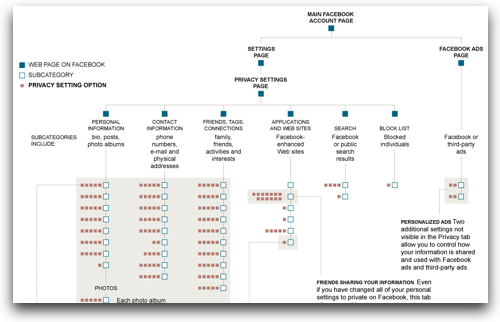
If you haven’t seen this graphic from the NY Times piece, “Facebook Privacy: A Bewildering Tangle of Options“, you really should check it out (click on the image to see the full graphic):

facebookprivacyillustration-1.jpg

The piece notes:

To manage your privacy on Facebook, you will need to navigate through 50 settings with more than 170 options.

And this is to make it simpler?

The companion NY Times article, “Price of Facebook Privacy? Start Clicking“, is worth a read as well, pointing out for instance that the text of Facebook’s Privacy Policy is longer than the text of the US Constitution! 🙂


If you found this post interesting or useful, please consider either subscribing to the RSS feed or following me on Twitter or subscribing to my email newsletter.


Facebook Customer Service FAIL – disabling an account and not communicating

facebook.jpgIn a conversation at the VoiceCon conference last week, I ran into another instance where the control of Facebook by a single company and also it’s “walled garden” aspect gave me more concern. As (industry analyst) Irwin Lazar outlines in his post on the Enterprise 2.0 blog, “Using Facebook for Your Customer Community? Think Again!“, he is now locked out of his Facebook account.
Let’s look at what happened:

  • Someone malicious cracked his Facebook password, logged into his account and started sending messages to his friends.
  • His friends alerted him and he immediately went in and changed his FB password.
  • He reported the attack to Facebook.
  • Facebook disabled his account.
  • Per Facebook’s instructions, he emailed “disabled@facebook.com” asking for his account to be reinstated.
  • He’s now been waiting over 10 days….

As Irwin points out, he’s sadly not alone with this problem. Still, as Irwin notes, if a company is going to use Facebook as part of their communications strategy they need to be sure that they can use Facebook! A good step is to have multiple administrators on any Facebook page (we do on the Voxeo page).

Facebook, too, needs to step up here a bit. Irwin, who in addition to being an analyst has a security background (and is, like me, a CISSP), did the right thing by fixing the short-term issue by changing his password and then reporting the attack to Facebook. To then have his account disabled with no explanation and no communication is crazy!

If Facebook wants to be the big portal through which we all view the Internet (and which continues to concern me), then they need to provide the level of service – and responsiveness – appropriate to that grand vision of theirs.

Even better would be to open up their system so that Irwin could have more control over his own account and data… but somehow I don’t see Facebook ever becoming the distributed and decentralized system we really need it to be…


If you found this post interesting or useful, please consider either subscribing to the RSS feed or following me on Twitter or identi.ca.


Facebook for iPhone 3.1 – ALL your *iPhone* contacts belong to us! (HUH???)

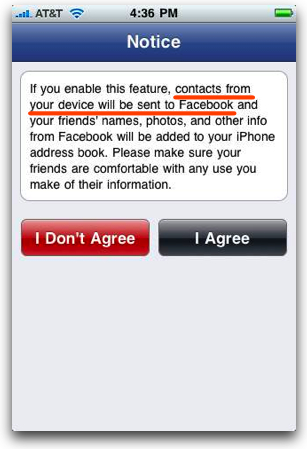
facebookforiphone.jpgAfter installing the brand-new version 3.1 of the Facebook for iPhone application, I started to enable the “Sync” feature to sync my Facebook contacts with my iPhone contacts, when I was VERY put off by this warning screen shown on right:
If you enable this feature, contacts from your device will be sent to Facebook and your friends’ names, photos and other info from Facebook will be added to your iPhone address book. Please make sure your friends are comfortable with any use you make of their information.

So my basic issue is this: WHAT IS FACEBOOK GOING TO DO WITH OUR iPHONE CONTACTS?

Obviously the app has to send my iPhone contacts up to Facebook so that Facebook can match up the contact info with the names of my friends in Facebook.

But then what?

Does Facebook then ignore my contacts? Are they stored in Facebook’s giant databases? Will they all be spammed with info about joining Facebook? (“Dan York is on Facebook, why don’t you join?”)

I looked for some kind of privacy policy or other info in the Facebook app… on the iTunes page, on the page for the Facebook for iPhone app. I can’t find one anywhere.

I do have people in my iPhone address book who have given me private/unpublished numbers. I’m not really comfortable having all that data sent up to Facebook if I have no idea what they are doing with it.

What’s the deal, Facebook?


If you found this post interesting or useful, please consider either subscribing to the RSS feed or following me on Twitter or identi.ca.


The Incredible Danger of Facebook’s New Privacy Policy – And How to Protect Yourself

facebook.jpgLet’s be very clear. No matter what the blog post or letter from Mark Zuckerberg may say (or update blog posts), Facebook’s new privacy settings have far less to do with “making privacy simpler” than they do with one simple fact:

Facebook has “Twitter-envy”.

Twitter is essentially the center of the public “real-time web” and is getting all the attention, hype and buzz. Facebook is not getting that attention and wants to be your single portal to the Internet.

Facebook wants you to share your information PUBLICLY.

The new “Privacy Policy” is not so much about protecting your privacy as it is about getting you to make more information public.

Let’s be clear. THAT is the goal. If Facebook were serious about making it easier to protect your privacy, the recommendations would be different. The “making privacy strong” theme is spin. And judging by articles I’m seeing in the mainstream media, it’s working. Now, to be fair, there are some improvements, like the ability to change the privacy settings of each post you make, but that improvement is overshadowed by the larger danger.


THE DANGER

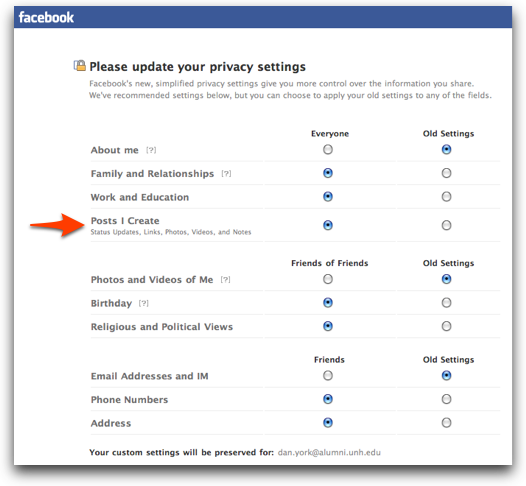
The fundamental issue is that when you are brought into the new “privacy transition tool”, the “recommended settings” are that you share all your status updates, links, photos, videos and notes publicly. Not just with other Facebook users, but with the entire Internet. By accepting the recommended settings, you are agreeing to make all the info you put into Facebook accessible through search via Google, etc.:

facebookprivacywizard-1.png

So all those silly status updates you wrote? Found in Google. All those “private” photos of your family that you previously just shared with friends? Found in Google. All those longer notes that you were sharing with your friends? Found in Google. Whether or not you are single or married? Found in Google.

It is a fundamental shift in information sharing from being inside a private walled space to being in an open public space.

Everything you publish – available to everyone on the Internet.

The danger I see is that many, if not most, people will simply accept the recommended settings. And suddenly information they thought was kept more private will be shared with the world.


HOW TO PROTECT YOURSELF

My recommendations are very simple:

1. Do NOT accept the recommended settings. Choose “Old Settings” in the Transition Tool.

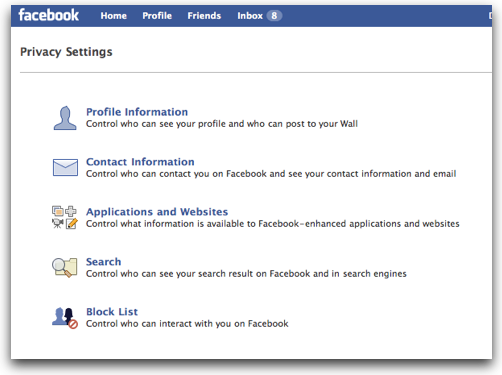
2. Go into the Privacy settings and examine all settings. Click the “Privacy” link at the very bottom of a Facebook page or going into “Settings” in the upper right corner and then click on “Privacy”.

facebookprivacysettings.png

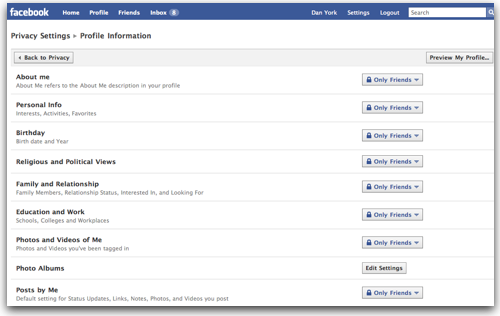
3. Change who can see your profile information. Click on “Profile Information” to decide who you want to see information about you.

fbprivacyprofile.png

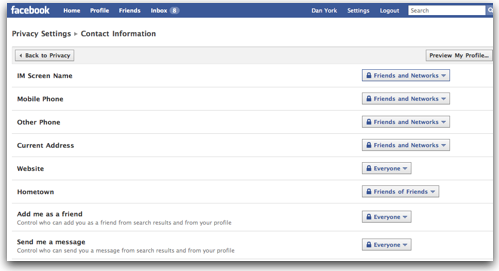
4. Change you can see your contact information. Click on “Contact Information” to decide who can see your contact info:

fbcontactinfo.png

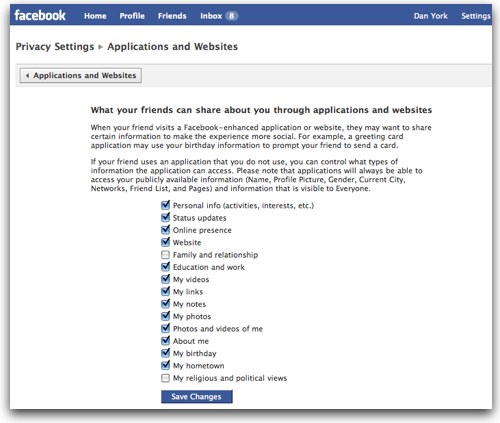
5. CHANGE WHAT YOUR FRIENDS SHARE ABOUT YOU! This is a critical one. Whenever your friends go off and play one of those games like Mafia Wars or Farmville, or take one of those zillion quizzes, they are sharing information about you, including with “game developers” who have questionable backgrounds. Everytime any friend of yours adds any Facebook “application”, they are sharing info about you.

Click on “Applications and Websites” to see where you can turn it all off:

fbprivacyapps.png

Personally, I’ve unchecked all of these items. If one of my “friends” on Facebook decides to start interacting with a new Facebook application, that is their choice. But I don’t necessarily want that external company or organization to get all this information about me.

I admit that I find it rather annoying that Facebook provides no way in its new “Privacy Transition Tool” to change these settings. You have to go into these settings to change it.

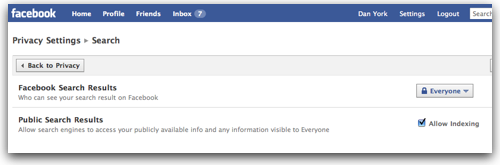
6. Change what information is accessible via search. Click on “Search” to change whether you want your information to be found via a Google Search:

fbprivacysearch.png

If you go through each of these panels and make sure the changes reflect how you want your information shared, you’ll wind up in a much better space with regard to privacy.


THE EVEN GREATER DANGER

There is an even greater danger to privacy lurking in the fine print:

facebookpai-1.png

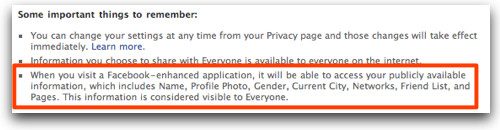
Facebook has reclassified what is “publicly available information”. Your name… profile photo… and friend list are now “visible to everyone“. And guess what?

There’s nothing you can do about that (except, perhaps to not use any applications).

It’s just the price of using a walled garden service like Facebook where a single company is in charge.


THE DISAPPOINTMENT

I understand Facebook’s business need to push people to share more information. They feel they need to be the center of the “real-time web”… and they feel that Twitter is in a better place to be that. But I find it annoying and frustrating that so many users are now going to find their “private” information publicly accessible out on the public Internet simply because they accepted the “recommended” settings.

Bad move, Facebook.