Category Archives: Twitter

A truly *useful* example of using Twitter for local alerts…

I was somewhat amused when local TV station WCAX started using Twitter… I first learned of it when they started following my twitter feed. At first I didn’t follow them in return (purely because I am getting a lot of Twitter followers and I like to check them out before just following them), but yesterday I decided to start following them purely to have another source of local news.

Today, I saw a great example of how Twitter could be used for local alerts:

200711060900

Now, working in a home office, this doesn’t really impact me, but I did call my wife who was out doing errands and let her know to avoid the highway. Tomorrow, I’ll be heading up to FacebookCamp Montreal and this type of message could help me decide which of the exits I would use to get on the highway.

Nice to see… and now a good reason for me to continue following WCAX’s feed.

There’s also an irony here, in that I don’t watch TV, so this Twitter feed is really my only exposure to WCAX and their brand. (Outside of obviously knowing that they are around.)

Technorati Tags:

Follow preparations for PodCamp Boston via twitter.com/podcamp

200710250836In the “cool uses of Twitter” category, you can now follow the stream of conversation about this weekend’s PodCamp Boston 2 via Twitter. Just go to http://twitter.com/podcamp to see the posts. If you are a Twitter user, follow the podcamp account and those posts will appear right in your normal Twitter feed.

The cool thing is that to contribute to the “podcamp” stream, you simply need to start following the ‘podcamp’ Twitter user and then type “pod” followed by a space and a message as a Twitter update. Your post will appear in the podcamp feed after a minute or two. This was apparently set up by kosso and uses the Twitter API. Neat to see this kind of “group” functionality…

Technorati Tags: ,

The fractured conversations of Twitter, part one: You don’t know if your conversation partner is following you!

Despite many views that Twitter is about conversations, it’s an imperfect conversation tool at best.  Consider two recent exchanges, first via IM with a friend:

Them: dude, can you add me in Twitter?  <URL>
Me: Huh?
Them: Can you follow me in Twitter so we can communicate that way?
Me: Sure, but why given that we can already communicate this way?
Them: Because I’ve replied to several of your tweets but you don’t see them because you don’t follow me. I prefer to reply in the medium in which the question is asked.

(I added him.) And then an exchange with someone asking them why I should add them as a Facebook “friend” when I didn’t think I knew them:

Yes good question . simple Answer . We twitter mostly ( I am <twittername> ) . Also as a subscriber to your blog …<snip>

Well, no, WE don’t “twitter” because I wasn’t following the person.  (I am now.)  And in fact when I looked at their Twitter pages there were indeed several different “@danyork” posts that I have simply never seen.

This is the problem inherent with Twitter “conversations”… you don’t easily know if the other person is seeing your tweets

There’s the disparity between people you are following and people who are followers of your twitter stream.  When I look at my twitter page, I can see these stats:

image

So updates/tweets from 78 people show up in the Twitter stream that I view.  However, feeds for at least 115 people that read my Twitter feed are not being seen by me.  I say “at least” because I know of at least one person I follow who does not follow me.   There may be others.  For those 115+ people, if they put a “@danyork” at the beginning of their tweet… I won’t see it!  And so their contribution to the conversation is ignored.

Now there’s a separate discussion about why I haven’t necessarily added all those followers to the list of those I follow (and I’ll blog about that another time – suffice it to say that it’s mostly an issue of just not having the time yet to check out all the Twitter invites I receive), but for the moment let’s think about the impacts to the conversation.  The person that starts following my feed may feel compelled to answer a question I pose… or to send along a URL they think might be of interest.  Or to pose a question to me. So they do “@danyork” and type away.  I never see it and never reply.

Does the person think I am ignoring them?  Do they think I’m arrogant and don’t view their posts as worthy of responding to?

And how would the Twitter user know?  Unless he/she kept track of all the Twitter notices they received about who was following them… or went to my twitter page and looked to see if they were listed there (I’m suddenly imaging some blog readers and twitterers doing exactly that!)… they have no way to know that I am or am not following them.

So yes, Twitter is about conversations… but many of those conversations may be fractured or disjointed – or disconnected.

Technorati tags:

SocialNetworkDevCamp – an unconference for developers interested in mashups and APIs in social media tools…

imageWhat are you doing on September 8th and 9th, 2007?  If  you are in the San Francisco Bay area (or can get there), and more precisely Richmond, California (a bit north of Oakland and Berkeley), it appears that there will now be an “unconference” called “SocialNetworkDevCamp” with the purpose:

SocialNetworkDevCamp will focus on API and Widget development from Facebook, Twitter, Pownce, Linked In and others. The camp will also start the process of identifying open APIs and data structures which would facilitate the creation of open standards for social networking.

Very cool to see…. and hopefully it will stimulate a good bit of discussion and action around the potential mashups that can occur between all these various services.  “Open standards for social networking” would also be very good to see!

If are interested in attending, just edit the wiki page and add yourself to the list of participants (or volunteers).

(Tip of the hat to Julian Bond for raising this issue in a Skype groupchat focused on mashups.)

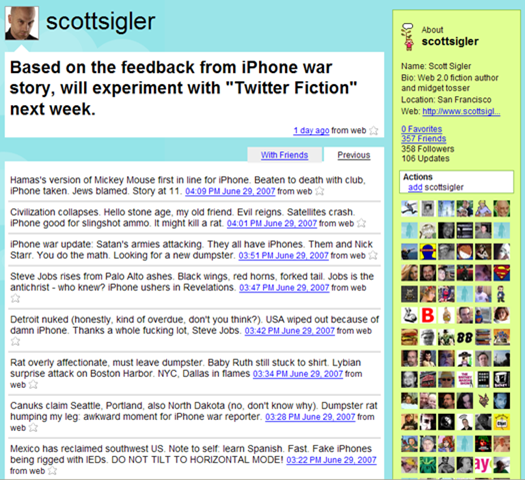
Twitter as an outlet for "fiction"? Scott Sigler shows how it could be done with "the iPhone War"…

image Twitter has been labeled many things… but I don’t know that I’ve yet seen anyone talking about it as an outlet for fiction.  However, Scott Sigler is now experimenting with it as exactly that.  This came about because last Friday (iPhone Day, in case you have somehow forgotten), Scott started a series of tweets (first one here) that escalated into what was called the “iPhone War”.  In a series of what looked like posts from an embedded war reporter (albeit one in a dumpster), he rapidly had Canada, Mexico and Russia invading the US to get all of our iPhones, the USA being wiped out and the ultimate collapse of civilization.   (Unfortunately with Twitter in order to see them you’ll need to go back in Scott’s Twitter page to see the posts – you also can get a taste by clicking the graphic on the right to see a larger version and some of the text.)  It was an entertaining diversion to read. (Hat tip to the tweet from C.C. Chapman that clued me in to it.)

C.C. implied that the “iPhone War” storyline was picked up by other Twitterers, i.e. they joined in, but I didn’t see those tweets and unfortunately I don’t know of an easy way to pull that all together.

Scott Sigler is now continuing his experiment with another short story that he put up back on July 2nd.  Not quite as personally compelling to me as the “iPhone War”, but an interesting experiment nonetheless.   Fun to see people trying to use new tools in old ways (telling stories).

Technorati tags: , , ,

Pownce pummels you with email notifications… and the inevitable comparisons to Twitter

On Day 2 of using Pownce – and remembering that it is in “beta” – my initial reaction was one of complete disgust at the sheer number of email messages that the site generates by default.  I mean, who in their right mind would think that people would want email notifications for basically everything that happens on the site?  Now, maybe there are people out there who don’t get as much email as I do, but sheesh…

image Thankfully there is a way to turn off the notifications to reduce the flow.  I think the “Plain message received” is the biggest culprit.  It seems that anytime any of your “friends” send you a message you wind up with an email message letting you know that you have a new message!  Get more than a few friends and… ta da… your email inbox is deluged!  So here would be my #1 feedback item to the developers:

Turn most of the notifications OFF by default!

Maybe just the “Pending friend request” and “Event invite received”.  Or put the notification screen as part of the signup process so that when someone is joining Pownce they see all this and can specify what they want.  All I know is that my initial reaction on opening up my personal email this morning was that I almost immediately wanted to get out of Pownce!

As the bright, shiny object chasers keep moving to Pownce, there are the inevitable comparisons to other darling, Twitter, and while I don’t have the time to write up my own thoughts today, a blogger named Tamar Weinberg posted a nice  comparison: “Twitter vs. Pownce: Who Pwns?” that captures a lot of the differences very nicely, complete with screenshots.   I agree with most of her points.  The biggest difference to me seems to be APIs.  With Pownce you must use either the (non-auto-refreshing) web page or the separate Pownce application.  With Twitter, you can use the (auto-refreshing) web page, but there are now a ton of other apps that allow you to update Twitter.  You can also connect to Twitter from other applications/devices that fit within your normal daily workflow.  So, for instance, when I am in my home office, I use “twitter4skype” to read tweets from friends directly in a Skype IM chat window and post my own updates to Twitter.  When I am on the road, I use my blackberry to SMS in updates (and could read them on my BB via SMS if I wished to do so).  I have also updated Twitter from within Facebook.  The key point is – I don’t have to run yet another app on my PC, or be limited to having to go to a specific web page.

We’ll see.  I like the “Sets” that are part of Pownce, and the idea of sending files is interesting (but, gee, I can do that with any of my IM clients!)… but I really don’t like having to go to the one web page (or using the app).

Noah Mittman also chimed in with a post comparing the two and offering the view that Twitter is aiming at being a multiplatform messaging system while Pownce is aiming to be a multipurpose “sharing” system.  I understand the difference he’s making, but it seems to me that right now people are viewing Pownce as primarily a better version of Twitter.  It still to me is a micro-blogging/status/presence system.  As to the “sharing”, my ongoing thought is that we already have so many different ways to share files and links (as I count the number of IM clients I am running), that I’m not sure we really need yet another.

I think both Pownce and Twitter are stepping stones toward something else that amalgamates all these different communication needs…. I’m not sure what precisely that is (or I’d launch a startup!)…

Pownce, Twitter, Jaiku, Facebook… and the perpetual quest for the next bright, shiny thing…

Does this sound familiar?  There is suddenly a site about which absolutely “everyone” you know is suddenly talking.  Suddenly, you have just got to join that site – but of course you must have an invitation and they are hard to get.  You are, though, being asked by all sorts of people you know… who keep telling you how great it is and how this new site will completely revolutionize the Internet and fundamentally alter the way in which we communicate.  Once you give in and join you suddenly find yourself deluged in requests to be added as a “friend” by some people you know and then also by many others you have no clue who they are.  It’s the “new” Internet.  It’s the end of everything old and the start of everything new.  It’s the best invention since sliced bread.  You just gotta see it!

What site am I talking about?

Hmmm… how about Orkut in 2004?

That was certainly the view in those days…. everyone was madly adding Orkut friends, filling out their Orkut profiles… wildly creating “communities” within Orkut and finding new communities to join.  Just like today’s Facebook Groups, you could learn a great amount about someone by the communities they joined.  Private messages were flying back and forth and it was just the place to be, even if many were uncomfortable with the focus of the site on dating.

But then somewhere along the way a good number of folks, myself included, were off to chase the next bright, shiny thing and we stopped checking in to Orkut all that often.  Spam increased within the site, the Brazilians took over … and the rest is history.  There are obviously still a lot of folks using the site, and occasionally I get a message in email that reminds me I need to go visit (usually to remove the “scraps” that spammers leave).

The pattern repeats and repeats and repeats and repeats….

After Orkut, the place to be was LinkedIn… Friendster… Xing… LiveJournal… MySpace… today’s darling seems to be Facebook.

Over the past months “presence services” have seemed to be the rage.  First it was Twitter… then there was a “great migration” over to Jaiku…. then some folks started thinking Facebook status updates were the best… meanwhile all the IM addicts were wondering how these new services were all that different from the IM “advisory” or “mood” messages people had been changing for some time.  (And fundamentally they really aren’t different, except that you can get them via RSS or on a web page and thus have a history.)

image Now, today, some of the Twitter-addicted seem to be convinced that Pownce is the next bright, shiny thing and it will solve all the problems with Twitter and bring us to communication nirvana.  Naturally, being a professional chaser of bright, shiny things, I had to sign up for Pownce.  First impression is that it’s a lot like Twitter with better replies and a way to have both public posts and also ones only visible to your friends.  (Which, of course, I’ve had from a blogging point of view with my LiveJournal account since back in 2004.) Okay, and it has its own desktop software.

Of course, to use it means that I have to rebuild a list of “friends” similar to the lists I already have in all the aforementioned presence, IM and social networking services.  I will, naturally, because there is something in my mental makeup that compels me to try out new services like this.

Meanwhile, of course, someone else is telling me that Hictu.com is really the place to be… if I’ll just go there and sign up, the mist will be lifted from my eyes and everything will be amazingly clear.   Hmmmmm…..

Ken Camp starts a new series of posts on Jaiku and the new client for Nokia S60 phones

(Originally posted over on my Disruptive Telephony blog… but I thought it made sense here as well.)

imageI have not really written about Jaiku here at all… I have been meaning to explore it a bit more, but just haven’t had the time.  What limited time I have had lately has been more focused on Twitter, Facebook, Skype and the evolving mashups of all of those.

But Ken Camp has been writing and advocating Jaiku, and is starting a series of posts with his one today: “Unveiling the new Jaiku Client for Nokia – Part 1”  Ken is going to talk more about the new client for Nokia S60 phones.  But this part of his first post is perhaps more revealing:

First, if you aren’t a Jaiku user today, you need to understand that Jaiku is what I call a lifestream aggregator. When you build your profile, you have complete control over what you wish to share of your lifestream of information. For many, that’s simply their Jaikus. Using this approach, a used can share brief snippets of information – current status, pose a question, leave a thought – for others to see.

Digging more deeply into Jaiku, we find you can also import RSS feeds of all flavors into your lifestream. For me, this means if you read my lifestream, you see blog posts from three different blogs, Flickr photos, blip.tv video posts, even Twitter posts. I’ll explain more about why I think this approach is revolutionary and exciting in a post tomorrow or Friday. It’s taken me a while as a Jaiku user to develop an appreciation for just why this is apprach to aggregation is really important. I think it’s positively revolutionary from a social networking perspective.

I agree with Ken that this type of “lifestream aggregation” represents a direction in which social networking is evolving.  The challenge, I think, really comes back to where you do that aggregation.  Jaiku would like to be your aggregator.  So would Twitter (which can bring in RSS feeds through sites like Twitterfeed.com).  And so indeed would Facebook which now includes an RSS application as part of its platform.

So which do you choose?

All are, to varying degrees, walled gardens of some sort.  Ken can’t follow my status updates because I primarily use Twitter.  Alec Saunders does most all his updates within Facebook.   We do need to have some kind of common aggregator.   We need to tear down the walls so that we don’t wind up in isolated islands of communication.

But in the meantime, if you want to read about how pretty and nice it is inside of the walled garden of Jaiku, head on over to Ken’s post to read more.  This is Part 1, with the others to follow soon thereafter, I would expect.

What the heck is Twitter good for? ZDNet shows a way to use it…

imageWhat the heck is Twitter good for, anyway?  While many of us use Twitter, I think it’s fair to say that we’re all collectively still experimenting with exactly the best ways to use it.  Certainly it has evolved from being the mundane “Went to lunch. Had a ham sandwich” into being a channel for passing around news.  I’ve certainly found links through the people I follow on Twitter far faster than I would have necessarily come across them through my RSS feeds.  (Mitch Joel has a similar story about the “Twitter News Network”.)

But what does a company do with Twitter?  How can it best be used as a communication vehicle for a company?  Obviously the BBC and others have been using it for news.  ZDNet may provide one other answer – they have a Twitter account, twitter.com/ZDNetBlogs, for following their blog postings

Now, you might say, isn’t that the role of an RSS feed?  Certainly.  In fact, if you go to ZDNet’s main blog page, you will see that they do, if fact, have a master RSS feed for all their blog postings (hosted by Feedburner – on a side note, I’m surprised that someone like ZDNet didn’t pay for Feedburner’s service to maintain their brand for their feed).  So the savvy web user could simply subscribe to that feed and be done with it.  I’m sure some people do.

But perhaps the point is that for people who come to use Twitter as a “news network”, this becomes a way that ZDNet can join in that newstream that people watch.  I haven’t spent much time analyzing it, but I do note that the ZDNet twitter stream is a subset of the ZDNet blog RSS feed.  Is it just certain articles they want to highlight?  Or certain blogs within their network of blogs?  I don’t know… but the net is that they are providing yet another way that people can find their way over to ZDNet’s content.    And they can see the results… there are currently 106 “Followers” of the ZDNet Blogs Twitter account.  106 people… many of whom are definitely in the “Early Adopter” camp.  Not a bad audience to get in front of if you are company with “high tech” content!

Kudos to ZDNet for experimenting with Twitter… I hope it works out for them.

Technorati tags: , ,